Friday, 6 December 2019

Ida’s Valley Homesteads


CAPE ARGUS – 1939, January 3
Stellenbosch was the favourite child of Simon van der Stel. He loved it for its beauty, its fertility, and the pleasing contours of its hills and valleys. He gave its name to the embryo village, and he granted land to several of his friends in the Ida’s Valley, most lovely of all the valleys, under the shadow of his own Simonsberg.
Several of the old homesteads still survive. Time has dealt with them kindly. One of these is RUSTENBERG, on the land granted to the Landdrost Peter Robbertz, who came to the Cape in 1696. The house is H-shaped, with white-washed walls, large, low windows, simple gables and a thatched roof. The curved steps leading up to the flagged stoep are made of tiny Batavian bricks, brought over by the Dutch East India Company at the command of the first owner. A grant of land nearby was made to the Huguenot exile, Francois Villon, of Clermont, in 1692; and he probably lived in an earlier house, traces of which may still be seen, near the present homestead of Ida’s Valley. The neighbouring farm of Schoongezicht, for long the property of John X Merriman, also has a charming house, built rather high up, with a view of the Stellenbosch valley.
RUNNING WATER
Every homestead in the valley has white-washed walls and a thatched roof, and is surrounded by oak trees and running water.
There sluits of water round the house are a tradition surviving from the old days when, in the summer-time, the slaves used to lay the dust around the house by scooping water out of the sluits with a tin dipper, and sprinkling it liberally over the road.
This is not the only thread left from the tapestry of past years. Everywhere are to be found signs of earlier settlers, and of their customs and way of life. At Schoongezicht wine is still made in the gabled wine cellar, and the grapes are still pressed out by human feet. At Rustenberg, the slave hole under the house is now used for the more prosaic purpose of storing logs of wood, but it is still very dark and mysterious. In the loft under the thatch apples and pears are spread out on straw to keep for the winter months. Thrifty Dutch housewives of a century or more ago kept their stores in much the same way, in the days before cold storage was though of, and they hung their bunches of herbs and their home-cured hams on the same broad rafters.
The old homesteads in the valley were built for coolness, with high ceilings, thatched roofs and large windows. All the rooms are large and rather draughty. Fireplaces are scarce, and it would need a roaring fire to warm those huge, airy rooms. It is supposed that earlier tenants just retired to bed with a large, copper warming-pan when winter frosts set in. Present owners installed fireplaces and plenty of electric heaters.
MODERN HOMES
Besides the old Dutch homesteads of Ida’s Valley, Schoongezicht and Rustenberg, there are some charming new houses in the valley, which have been built on bits of land cut off from the three original farms. One of these is Kelsey Farm, built on a hilltop above Rustenberg – a low-eaved thatched house with a peerless view and surrounded by vineyards. Another is the House in the Woods, built among the poplar trees on a piece of Ida’s Valley. Numerous other cottages have sprung up as more and more people have realized what a delightful part of the world this is in which to live. All are comely, with their thatched roofs and white-washed walls, and are in keeping with the spirit of the valley.
The grey curves of Simonsberg rise above the valley, which is watered by springs from its ravines. Among the rocks near the summit live a troop of baboons, which raids the upper farms for fruit and mealies when roots get scarce on the mountainside. On the very top is an old Hottentot cave, supposed to have been the refuge of runaway slaves. But one cannot help feeling that only a very foolish or very frightened slave would leave the comfortable life of the valley for the inhospitable mountain heights.
THE FAMOUS OAKS
If you read through the dispatches of Simon van der Stel, you will come across this letter the Landdrost, Ditmars, of Stellenbosch, dated July 13, 1701. “We send you, for the benefit of the Stellenbosch community, a wagon laden with young oak trees, which with the co-operation of the Reverend Hercules van Loon, are to be planted – wherever possible. They are at once to be put into the ground, lest they perish through delay.”
This accounts, in part, for the beautiful old trees to be found everywhere in the valley. It was part of the governor van der Stel’s policy to plant plenty of oak trees, and he guessed how well they would flourish in this fertile soil. At Rustenberg is a giant oak tree filled with stones and cement to hold it up, as its core has long since rotted. Yet it still produces its crown of green leaves every summer, and gives every indication of robust life. It must be more than a hundred years old, and many generations must have sheltered beneath its gnarled branches.
TREES OF MANY KINDS
Besides oak trees, there are poplar woods, delicate and silvery; tall rows of Lombardy poplars to shelter the orchards, which in autumn are a golden delight; avenues of plane trees and flowering gums; a silver tree plantation; Spanish chestnuts in sheltered gullies; wild olives and fir forests on the mountain slopes. At Schoongezicht a giant mulberry tree bears its yearly crop of crimson berries. At Rustenberg weeping willows droop delicately over the swimming pool, until they nearly touch the blue water-lilies below; and on their branches, weaver birds build their nests.
So far, I have not even mentioned the fruit trees – in Ida’s Valley one takes them for granted. Since the business of the valley is fruit, every bud is watched with care, every south-easter dreaded once the fruit has formed, and all market prices studied with apprehension. The busiest time of the ear is the fruit season, starting in December and ending in March or April, when the last pears and apples have been placed in their wood-wool nests in the fruit boxes and consigned to foreign ports or home markets, according to their size, quality and degree of ripeness. The summer months mean constant toil to the fruit farmer as his merchandise is perishable. It must be picked and packed at an exact stage of ripeness, and like time and tide, it waits for no man.
Yet it would be impossible to get any real sense of hustle in this valley of green trees and cooling streams. One feels that land may be bought and sold, men may come and go, and farmers may sweat to wrest a living from the soil; but the tranquility of the year will remain in Ida’s Valley – a snare for settlers, a benediction to the world-weary, and a constant tribute to the good taste of Governor van der Stel. – The Hon. Yvonne de Villiers

Tuesday, 3 December 2019

Cape Wines in 1886

CAPE ARGUS - 1886, May 31
There is a greater “potency of wealth” in the news that comes from London, of Cape light wines selling freely at the Exhibition, than in all the gold news with which we are just now being titillated. The news is intensely gratifying, and promises well for an ultimate return for the large sum (to us) which we have sunk in the Exhibition; but it is still more gratifying to hear, as we lately have heard upon the most competent authority, that there is really some excitement amongst the wine farmers themselves, owing to the complete success which has attended the venture of a few of their number who have tested Baron von Babo’s methods by preparing in each case just one or two vats according to his directions. The wine so prepared, is clear and of beautiful quality; far superior to anything to which the wine farmers have been accustomed. Next year every one who has made the experiment will have the whole of his vintage so prepared, so that should a demand be created for good Cape wine, in a short time we shall be in the proud position of having the article with which to meet the demand. It is needless to say that not only will those who have thus prepared part of their vintage next year devote the whole of their crop to the improved processes, but their neighbours, convinced of what can be done, will come over to the same ways, and thus there is a better prospect for the farmer, out of his own progress, than from any legislation which could be devised.

Monday, 2 December 2019

Garden Route Touring Tips


CAPE ARGUS - 1939, December 26
At all times of the year, but particularly in the summer, the Garden Route between Port Elizabeth and Cape Town makes a strong appeal to holiday makers and tourists. The thousands who will travel that way by road will find the following information by the A.A. concerning one of the alternative routes in this area of considerable interest.
Assuming the trip begins at Port Elizabeth the road via Van Stadens Pass and Gamtoos to Humansdorp will be found under construction. About nine miles beyond Humansdorp keep left for the coast road which passes Clarkson and then runs between the Tsitsikamma Mountains and the sea. This is good road practically all the way, but in case of heavy rain the route via Assegaibosch and Kareedouw Pass is recommended. There are good camping sites near Storms River and Coldstream, and at Plettenburg Bay excellent fishing and surfing can be obtained. A trip by motor launch on Keurbooms River reveals the fine scenery. The forest and the furniture factories at Knysna are worth visiting.
One of the Prettiest Towns
Continuing to the Wilderness careful driving is advised crossing Phantom Pass and Homtini Gorge. Reaching George – reputed to be one of the prettiest towns in South Africa – the tourist may take the road over Montagu Pass to Oudtshoorn. This road is moderately corrugated, with steep gradients and dangerous bends. There are many delightful motor runs in this vicinity; e.g. the Swartberg Pass to Klaarstroom and returning via Meirings Poort; while the famous Cango Caves and Bushmen paintings should not be missed.


Thursday, 28 November 2019

Strand Golf Club


CAPE ARGUS - 1939, March 21
Mr. CL Murray presided at the annual general meeting of The Strand Golf Club last night. The annual report depreciated the lack of interest in the club shown by members. The report indicated that financially the club had never been in a stronger position. The total membership of the club is 179.
The election of office-bearers resulted as follows:
President: Mr. PHB Faure
Vice-presidents: Messrs. JG Morkel, HJH Claassens and CL Murray
Captain: Mr. Geo P Neill
Vice-captain: Mr. PJ Benade
Secretary: Mr. HC Solly
Treasurer: Mr. A Friedman
Committee: Messrs. I Black, HH Louw and EB Philip
NEW CLUB HOUSE FAVOURED
Mr. Benade spoke in favour of a new club house. Personally, he favoured a 19th hole if it could be done legally. Mr. T Fox expressed the view that visitors should be catered for. The ideal would be to build a club house on the beach. Mr. Benade said a club house on the beach under existing circumstances would be impossible because of the expense.
G Bryant, who was formerly a caddie at the Royal Sydney Golf Club, but is now a professional in New Zealand, will in future do his coaching on the high seas.
He has been engaged as a permanent professional for the new 27 155-ton liner, Dominion Monarch, which is now on her maiden voyage to Australia and New Zealand. He will take up his unusual occupation as a sea-going golf professional when the liner leaves Auckland on her return voyage to England in April.
The shipowners will supply nets, mats, clubs and balls. Passengers wishing to have tuition will pay a small fee per lesson.

Monday, 25 November 2019

Motor Vehicles in Japan


CAPE ARGUS - 1906, December 29
The motor vehicle has invaded the land of the rising sun, but Japan is far from being an ideal country for the modern vehicle. The roads (says the Industrial Motor Review) are as they have been for centuries, designed only for the most primitive traffic and with the same economy of space which is everywhere manifest. The city streets as well as the country roads average less than 25 feet in width. People and vehicles mix indiscriminately, and look out for themselves as best they may. A 25-feet street is considered a wide one. In many places a motor vehicle with a top would be compelled to put it down rounding a corner, to keep from knocking down awnings. An attempt was made some time ago to have the streets widened, but the inhabitants indignantly protested, because if this took place, they could not walk the centre of a business street, and view the shop windows on either side. The streets of the towns are bad, but those of the country are worse. Many are not six feet wide. Between Nogaya and Kobe there are about 150 miles of fairly good roads, but there are three large rivers to cross, and to make things worse there are no bridges. To read the foregoing remarks one would think that prospect of introducing the motor vehicle to such a country is remote. But the fact is otherwise. Motor vehicles of all descriptions have been introduced, and their number is constantly on the increase. It is an old axiom that the Japanese do everything backward. Here is one example: In other countries the touring car has been the forerunner of the utility vehicles, but in Japan it is reversed – the industrial motor vehicle has taken the precedence. The Japanese have long been chiefly dependent for transport on what they call abbreviately “rich-shas.” Therefore, it is evident that such a condition of offers a wide field for motor buses. The first company that took up the introduction of industrial motor vehicles with serious intent was Osaka Jidoska Kaisha, to operate in Osaka. Seeing that there was a future in Japan for motor vehicles both for passengers and goods, a large order for chassis was placed with an American firm. The bodies of these chassis were made in Japan. The company started out with the utmost care and conservatism. It hired as head mechanic a young man who had been educated in Glasgow. An expert from America was also employed.

Detergents through the ages

JEYES' DISINFECTANTS 
To prevent infectious Diseases, disinfect your homes, business premises, Stores, etc. with Jeyes’ Special Fluid Cyllin, the most Powerful Non-Poisonous Disinfectant known to Science. 3d. worth will do the same work as One Gallon Carbolic Acid.
CAPE ARGUS - 1906, December 5


SUNLIGHT SOAP
Sunlight soap stands for Cleanliness. Clothes worn by little children should always be washed with pure soap.
THE STAR Johannesburg - 1918, February 9

SCRUBB'S AMMONIA 
Try it in your bath, to clean your toilet, for household purposes, to soften water, to wash your hair, to end itchy insect bites, to let your nickel items shine again, to clean carpets and clothes. Available at all Grocery stores and Pharmacies.
DE VOLKSTEM - 1925, December 31

MIN  – The HalfMINute Polish
You’ll save yourself a lot of trouble by using MIN, the halfMINute polish. In about 30 seconds MIN gives a beautiful finish for the Piano and all highly-polished Furniture. MIN also gives a lustrous sparkle to Glazed Tiles, cleans and polishes Porcelain enamel Baths and Basins and makes it so easy to keep White Enamel Paint spotless.
THE STAR Johannesburg - 1935, July 26

VIM - A Sparkling Home all over – But no Spoiled Surfaces!
You’d like your home to be the envy of your friends? You’d like a polished gleam in every room? You’d like to keep surfaces safe, unscratched? Well, just say: “JIM! VIM!” – and say it often!
VIM cleanses twice as well in half the time! It whisks away grease and dirt so smoothly – leaves a brilliant shine behind, with never a scratch. You see, VIM has a double action in cleaning. The dirt is first loosened and then held in a soapy foam ready for one easy rinse to remove it all. VIM’s surface-saving cleaning makes things sparkle and keep on sparkling. Today, make this easy test. Just go round the house; look at the kitchen – the floor, the sink, the table, pots and pans. Look at the bathroom – the tiles, the bath and basin. Then VIM the lot. You’ll have a brand-new home in no time! Try it and see!
CAPE ARGUS - 1939, February 6

Thursday, 21 November 2019

Cure for Whooping Cough, Croup, Bronchitis, Influenza, Colds


Cure for Whooping Cough
CAPE ARGUS - 1939, December 16
Shirleen Hockman (4) of Doornfontein, was one of several children whose parents used the Dingaan’s Day holiday for flights at the Rand Airport to try and cure them of whooping cough.
Mr. JT Slabbert, who took them up in his Waco plane, said this method of curing whooping cough appeared to be growing in popularity with parents.
When he took up Shirley Hockman, who was accompanied by her mother and a friend, he climbed to 12 000 feet, and then did three dives of about 200 feet each, the effect of which, it is claimed, breaks the cough and ensures recovery.


Bronchitis cured by BORSTOL
CAPE TIMES - 1933, August 9
“I cannot tell you how glad I am that I tried BORSTOL. After suffering for 18 months with acute Bronchitis, BORSTOL Inflammation Oil was the only thing that cured me.”
Clock Tower products are safe and reliable.

THE STAR Johannesburg - 1918, Jan. 10


Croup cured by Chamberlain's Cough Remedy
THE STAR Johannesburg – 1918, February 21
When Jennie had her first attack of Croup, it grieved her mother to listen to the choking cough and watch her gasping for breath. She quickly found that there is no need for alarm when one uses Chamberlain’s Cough Remedy. If given as soon as the child becomes hoarse, or even after the croupy cough appears, it will prevent the attack. Always keep Chamberlain’s Cough Remedy in the house. 


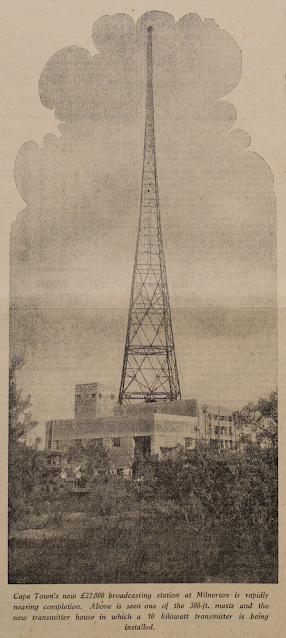
Cape Town’s new £22 000 Broadcasting Station at Milnerton

 CAPE TIMES - 1933, July 18 The Cape and Peninsula Broadcasting Association started Cape Town’s first Broadcasting Station on September 15, ...