Showing posts with label America. Show all posts

Friday, 7 February 2020

Tips for Waiters

CAPE ARGUS - 1927, August 2
Tips are given and taken in this country as a matter of course, but there are rare occasions when tipping is not tolerated. It is an unwritten rule that waiters at public banquets are not supposed to hold the guests up at ransom. The rule recently has been flagrantly broken by waiters at big West End hotels. At several public dinners I have attended lately waiters have sidled up towards the end of the meal to suggest that their services should be “recognized.” The classic formula employed is “I hope you are satisfied, sir,” and if that does not produce a pocket to pals reward more direct methods are used.
“A London Visitor,” in a letter prominently displayed in the “Daily News” draws attention to this abuse. He relates an incident in which Lord Burnham this week, at an International Press banquet, formally requested his guests not to give any tips to the importunate waiters. At this, as well as at other banquets, adequate arrangements had been made to cover the usual gratuities to waiters, but these grasping gentlemen wanted additional “extras.”
ENDURING BUGBEAR
“The incident,” says the “Daily News” correspondent, “raises in an acute form the question of tipping, an enduring bugbear to visitors to London. One tips without demur in the ordinary way when dining at a hotel, but it is new to me to be asked for a tip, as I have been on three occasions, by waiters in three different hotels at banquets similar to the one referred to. The question seems to need ventilating.”
THE UNINVITED GUEST
Tipping is a long established evil which cannot, it seems, be abolished. A more recent social problem which is being tackled with more determination is the problem of the uninvited guest. The habit of “dropping in” to parties without an invitation has grown alarmingly, both in this country and America. Some of these intruders are brought by friends who have single cards of invitation, many are simply “crushers” without scruple, with well-cut clothes and sufficient social address to stage an entry into drawing-rooms where they can enjoy free hospitality and the pleasure of mixing with “the best people.” A few may be well dressed crooks with sinister designs on the expensive trifles that glitter in West End ballrooms. All these types of intruders have become so persistent that givers of parties are now insisting that tickets of invitation must be shown at the door. “Punch” goes further and suggests that each authorized guest should show his or her passport (with photograph) on demand. 
The “uninvited guest” problem has given the practical joker a new opportunity for developing his wretched mania. It is considered an excellent hoax by some misguided people to send out bogus invitations to social functions. The latest hoax of this sort was discovered just in time by the intended victim, the Hon. Evan Morgan, who was celebrating his 34th birthday by giving a party to 150 friends, including Prince and Princess Arthur of Connaught, Augustus John, GK Chesterton, Alfred Noyes, the Sitwell brothers, Mlle. Spinelli, and Senorita de Alvarez.

Monday, 25 November 2019

Motor Vehicles in Japan


CAPE ARGUS - 1906, December 29
The motor vehicle has invaded the land of the rising sun, but Japan is far from being an ideal country for the modern vehicle. The roads (says the Industrial Motor Review) are as they have been for centuries, designed only for the most primitive traffic and with the same economy of space which is everywhere manifest. The city streets as well as the country roads average less than 25 feet in width. People and vehicles mix indiscriminately, and look out for themselves as best they may. A 25-feet street is considered a wide one. In many places a motor vehicle with a top would be compelled to put it down rounding a corner, to keep from knocking down awnings. An attempt was made some time ago to have the streets widened, but the inhabitants indignantly protested, because if this took place, they could not walk the centre of a business street, and view the shop windows on either side. The streets of the towns are bad, but those of the country are worse. Many are not six feet wide. Between Nogaya and Kobe there are about 150 miles of fairly good roads, but there are three large rivers to cross, and to make things worse there are no bridges. To read the foregoing remarks one would think that prospect of introducing the motor vehicle to such a country is remote. But the fact is otherwise. Motor vehicles of all descriptions have been introduced, and their number is constantly on the increase. It is an old axiom that the Japanese do everything backward. Here is one example: In other countries the touring car has been the forerunner of the utility vehicles, but in Japan it is reversed – the industrial motor vehicle has taken the precedence. The Japanese have long been chiefly dependent for transport on what they call abbreviately “rich-shas.” Therefore, it is evident that such a condition of offers a wide field for motor buses. The first company that took up the introduction of industrial motor vehicles with serious intent was Osaka Jidoska Kaisha, to operate in Osaka. Seeing that there was a future in Japan for motor vehicles both for passengers and goods, a large order for chassis was placed with an American firm. The bodies of these chassis were made in Japan. The company started out with the utmost care and conservatism. It hired as head mechanic a young man who had been educated in Glasgow. An expert from America was also employed.

Friday, 13 September 2019

Why Men will Fly like Birds

CAPE TIMES – 1933, September 28
In Science, Mechanics & Invention, the Age of the Bird Man is foreseen.
Today in the most matter-of-fact manner you step into your motor car, press the accelerator and quickly travel to your destination.
Tomorrow, as indicated by recent discoveries in the science of aviation, you will be able to strap on a pair of wings, set in motion the machinery that will make them flap, soar through the air and speedily reach your journey’s end.
Men will soon be flying like birds, according to Professor Antoine Magnan, technical adviser of the French Air Ministry. In an address before the French Academy of Science this authority on aviation vividly described the early development of a gigantic new industry, which would spring up almost overnight, for he foresees countless millions of winged men.8
Professor Magnan has been studying the flight of birds and insects for more than 20 years, with the idea of making aircraft more efficient. He has experimented with 500 different kinds of birds, as well as innumerable insects, and has written more than 30 000 detailed reports on flights.
NEW TYPE OF PLANE
This French investigator, however, is not alone in his investigations to solve the secrets of the investigations to solve the secrets of the bird’s power of flight. Johnathan E. Caldwell, of Madison, New Jersey, likewise has been studying for years the wings of birds to discover their secrets of aerial propulsion. As a result of his investigations Mr. Caldwell has designed a new type of an aeroplane which embodies many of the principles he discovered that birds use in flying.
Mr. Caldwell’s plane is equipped with three wings, instead of the bird’s one, on each side. His plane uses a rotary motion where the bird uses a flapping action. The three wings, revolving, give a balanced action, a fly-wheel effect. The valves in the wings open on the upstroke and close on the downstroke, and thus function exactly as the feathers in a bird’s wing. The power impulse on the down-stroke, when the valves are closed, is a lifting impulse, thus keeping the plane in the air. In vertical ascent and descent, the wings are maintained in a neutral angle and in forward flight they are tilted into a negative or gliding angle while revolving. Altitude is regulated by the degree of rotation and controlled by the pilot at the throttle.
The idea of man flying with beating wings is several thousand years old, but it has suddenly become practicable, Professor Magnan points out, because of the development of motors, of increased knowledge of air structure, and most of all, because rapid motion pictures have revealed the mechanism of winged flight.
THE “BIRD-MAN”
By ultra-rapid motion pictures, and by using mixtures of tinted smoke so that the air movements round a flying bird literally can be dissected, aviation experts now understand for the first time just what is necessary for winged flight and so the era of bird-men is at hand, Prof. Magnan predicts. “I am certain that in a comparatively short time, perhaps two or three years, men will be frolicking about in the sky like birds,” says Prof. Magnan. “A man fitted with two wings, each with four or five square feet of surface, can fly with his own bodily energy if he can make his wings beat somewhere between 13 and 20 strokes a second. The man and his machine should not weigh more than 220 lb. for wings of this size. Naturally the wings would have a full spread in the downward beat and be turned sideways for the upward beat. The angle of the arc made by the wings would be 45 or 50 degrees. The flier would hardly have sufficient power to climb, though upward wind currents would lift him, but he could fly horizontally as long as his strength held out.” Prof. Magnan describes the bird-man’s flying equipment as a motored machine consisting of a light frame, including a seat, with two wings. Each wing would be from 60 ins. to 80 ins. long and the shape of half a leaf, cut along the main stem, with the straight side forward and both ends pointed. The centre width would be from 20 ins. to 30 ins.
SMALL MOTOR
The wings would not beat straight up and down, but the course of an inclined and rather flat figure eight; that is, a long stroke downward and forward, a turn upward, a long rising backstroke, a turn upward, and then the long downward and forward stroke again. The number required would be between 13 and 20 a second, depending on weight and other circumstances but 20 is the maximum necessary and a small motor is sufficient to produce this power. Prof. Magnan has calculated that a man has sufficient physical energy to fly with wings on a horizontal line, as he needs only one-eighth of a horse-power, which is what a day labourer exerts in his work. But it will be far safer and more exhilarating for him to use a small motor no bigger than his hat. Extra and revolving propellers also could be attached like those of an auto-giro.


Watch Jarno Smeets, a Dutch mechanical engineer, take off and fly like a real bird just by flapping wings of his own invention. Smeets took notes from the albatross and this system allowed him to literally start flapping his arms to take off and keep flying.


Monday, 9 September 2019

First Penguins in Cape Town

CAPE ARGUS – 1939, March 6 & 15

The first Emperor Penguins ever seen in Cape Town arrived aboard the German vessel Schwabenland from the frozen South. Photographed with them is their “keeper”, Mr. E. Barkley who hoped to deliver them to the Hamburg Zoo.


Shortly after these penguins left Cape Town, a Golden Crest Penguin was found in the Cape Docks and a home was sought for this penguin.
WHO WANTS A PENGUIN?
One of the Golden Crest variety was found in the Cape docks by Mr. R. Charter, of the Division of Fisheries. At first, he thought it was the penguin which “deserted” from the American freighter West Isleta. A number of Jackass penguins were sent to the World Fair in this ship, but one slipped away before the vessel cleared and has not yet been found.
The penguin is about 14 inches high and has two golden “eyebrows,” the distinctive mark of the variety. Mr. Charter then thought the penguin might have escaped from the German ship Schwabenland, which had on board several Emperor and Adelie penguins, which it brought from the Antarctic and is taking to Germany. The Emperor penguins were the first of their kind ever to be seen in Cape Town.
According to inquiries made by Mr. Charter at the South African Museum, the Golden Crest penguin must have come from the Antarctic where they are to be found in large numbers. It is the only one in the Union at present.
It is thought that the penguin may have come in one of the whaling ships, but so far no one has come forward to solve the solution of how this Arctic bird arrived in Cape Town docks.
Today the penguin was taken to Mr. Charter’s home for the weekend. But he is not anxious to keep it and will gladly give it to anyone who wants it.

Wednesday, 28 August 2019

Advertising as a Career

CAPE TIMES – 1928, July 19

Important Posts Held by women
Of the many fields for women’s work which have developed in recent years that of advertising offers the widest scope and makes the most picturesque appeal. It is work for which the woman’s mind has an advantage over the mentality of the male. Advertising authorities, pointing to America and Great Britain, where many women in the advertising field now earn from £500 to £2,500 a year, agree that unparalleled opportunities in this profession are waiting to be seized by women in this country. There is a league in New York called “The League of Advertising Women,” and both London and New York have their Women’s Advertising Clubs. There is probably no profession in which the percentage of women holding responsible positions is so high as it is in advertising. This is no doubt largely due to the fact that it is of comparatively modern growth and women have not had to overcome prejudices that are deep rooted in tradition to the extent they have in some other professions.
There are many women directors of advertising agencies, at least two of whom have been in the business for 30 years or more and have advanced by the weight of great ability form subordinate positions to administrative posts, and in one case, to the chairmanship of a great advertising organisation. The most notable example is Miss. J. R. Reynolds, F.I.P.A., who arrived in Wellington this week.
A considerable number of the important posts in the advertising departments of the British newspapers and periodicals are held by women, including the coveted one of advertisement manager to London “Punch,” who rose to power because she believed in advertising, started her career as a copywriter on the staff of a London advertising agency. A large advertising firm in London has four women on its copy-writing staff, and one of its three commercial studios is staffed entirely by women. One of Sydney’s largest department stores has placed its advertising in charge of a woman. The advertising department of the “Queensland Country Press” is represented in Sydney by Miss Foote.
Appeal to Women
A factor that has had a considerable influence in providing their openings for women is that the bulk of advertising directs its appeal to women. One of the speakers at a British convention luncheon, at which a woman was in the chair, and for which the details were arranged by women in advertising businesses, emphasized the fact that 90 percent of the buying – not trading – in the world is done by women, and 75 percent of the shops in Regent and Oxford Streets, London, are for women alone. She quoted figures from an Oxford Street store which showed that 75 000 women each day passed in and out of the doors, inspecting goods or making purchases. The psychological effects of advertising are admittedly a highly important branch of study, and therefore the instinctive desire to bring women, into the profession, is thoroughly sound. A woman’s mind. With its love of detail and its big imagination, can appeal to prospective women customers better than the average man’s. 
The three chief branches of advertising offering wide scope to the woman expert are: 
(1) Advertising Management: the organization for business concerns of the advertising systems by which they aim to sell their goods. 
(2) Advertising Agency: the preparation and placing of advertisements and the organization of selling-schemes for trade advertisers. 
(3) Advertisement Management or the Organisation of Newspaper and Magazine Advertising. The sale of space by canvassing is an important feature of this branch of work.
For Clever Women 
Advertising is undoubtedly a profession in which a clever woman can secure big prizes. But it must not be thought that these prizes are lucky windfalls. They are the result of rigorous training, patient endeavor, and grueling work. One starts early, finishes late and when emergencies arise, burns a lot of midnight oil. But withal it is a fascinating business – curiously enthralling. It needs skill of a high order to put the facts of an advertisement in a form that will capture the imagination, and sway the buying moods of tens of thousands of people. It is work that gives a gratifying feeling of power and, being important work, it rightly commands high salaries. – “The Dominion” (New Zealand).


Wednesday, 21 August 2019

Alcohol test for drivers

Cape Argus – 1939, February 14
A new device for testing drivers for intoxication has been tried in America in 1939. A police trailer has been turned into a laboratory for country doctors to test drivers who were picked up at random and examined for intoxication. In the picture a driver is seen blowing up a balloon which later releases the breath into a special device that register any alcohol in the breath. If this is over a certain percentage a conviction automatically follows.

In South Africa, at an event in KwaZulu-Natal, the 2019 Easter road safety campaign was launched on Monday, 8 April 2019. The new Evidential Breathalyzer Alcohol Test (EBAT) system which will begin being implemented on the country’s roads was introduced, aiming to combat drunk driving by providing immediate, accurate information on a driver’s intoxication level. The Department of Transport already had four centres in place – including one in KZN, one in the Western Cape and two in Gauteng. Plans to open one in every province are going forward.

Apparently, this is a vast improvement over the older blood tests system - motorists could be detained overnight or until the end of the weekend. They could spend months facing legal uncertainty while waiting for the results. Relatively common under the previous system, were missing and incorrect results. Because the results of an EBAT test are instant the case can be dealt with swiftly and efficiently.


Monday, 12 August 2019

The "RUNAWAY PLANET" - OBJECT REINMUTH (HERMES)

THE STAR Johannesburg - 1938, 10 January 

The German astronomer, KARL REINMUTH, discovered “THE RUNAWAY PLANET” in 1937 when it zipped past Earth at about 800,000 km, just twice the distance to the moon. Unfortunately, astronomers lost sight before they could precisely determine its orbit. “THE RUNAWAY PLANET” - OBJECT REINMUTH 1937 UB (O.R. for short) missed the earth by 5½ hours on October 30, 1937. On 10 January 1938 THE STAR Johannesburg reported that Cape Town astronomers, Dr. H.E. Wood and Mr. Arthur W. Long, predicted that O.R. may be coming back in a few years’ time. The asteroid was named after the swift messenger god of the ancient Greeks, HERMES. 
After 66 years, on 15 October 2003, this kilometre-wide asteroid became visible again and the new orbit was firmly linked to the scant observations of 1937. Relieved astronomers announced that the potential killer rock will not get uncomfortably close to Earth within the next century. They predicted that HERMES will make its closest approach to Earth on 4 Nov. 2003, at a safe distance of 7 million km. They expect that it won't get any closer than about 3 million km within the next hundred years or so. According to astronomers it is hard to predict what will happen in the distant future, as HERMES seems to be very eccentric. At least HERMES won't get lost again, thanks to the new observations. 

(Additional info taken from an article by Govert Schilling:


Monday, 29 July 2019

National Lipstick Day - Tattoo your lips

THE STAR Johannesburg - 1935, July 29
Annually, July 29, is National Lipstick Day, and I was stunned to see an advertisement in THE STAR Johannesburg, 1935, July 29 – exactly 84 years ago! Women were told how to TATTOO their LIPS! The simply marvelous South Sea Stain for Lips promised a luscious, even, transparent color that’s actually a part of your lips – color that really stayed all day and that would keep lips invitingly soft and youthfully caressing instead of drying them. You had to put it on, let it set and then wipe it off. Only the color would stay. There were 4 simply ravishing shades available: Coral, Exotic, Natural and Pastel
Thanks to Wikipedia, I discovered that about 5 000 years ago men and women started wearing lipstick made of some funny stuff. Crushed bugs, crushed gemstones, ochre, dyes from cochineal, fish scales, crushed mulberries, beeswax, scented oils, deer tallow, castor oil, olive oil, mineral oil, cocoa butter, lanolin and petroleum oil were some of the ingredients used – even dangerous lead and vermilion. Sometimes lip color had been used for puberty rituals or only by the upper-class women, actresses, actors and prostitutes. As cosmetics was associated with loose girls or prostitutes, teenagers were discouraged from wearing cosmetics.
In 1884 French Perfumers invented the first commercial lipstick, sold in paper tubes, tinted papers, or in small pots. American women considered lipstick acceptable by 1912 and shortly after that, Maurice Levy invented a cylinder metal container for lipstick.
In the 1930’s, lipstick became a symbol of adult sexuality. It became scarce during the Second World War as petroleum and castor oil, some of the ingredients, were unavailable. In the late 1940’s, No-Smear Lipstick – the first long lasting lipstick - was created in New York and New Jersey by Hazel Bishop.
Later several types of lipstick became popular – dark red, shimmery, pink, peach, white, light blue, lime green, black, violet, matte, bright bold colors, nude, brown in tubes, lip balms, glosses, crayons, pencils, liners and stains.
You are welcome to read more about the history of Lipstick on https://en.wikipedia.org/wiki/Lipstick

Tuesday, 23 July 2019

Taking off One's Clothes

CAPE TIMES - 1933, 19 July


Miss JAN GAY, a young American, did the Grand Tour of the European Nudist Colonies in 1933.
GR Stevens reviewed ON GOING NAKED, Miss Gay’s book on the Ethics and Aesthetics of taking off one’s clothes.
Not fewer than 134 nudist colonies in Germany were listed where members might be as naked as the liked in parks or secluded retreats. Some were physical culture clubs, while others taught dancing or eurythmics. Sometimes Vegetarianism or similar practices were combined with nakedness. A few colonies were economic in intention, living and working under strict communism.
Miss Gay did not throw any particular light on the motives which underlie nudism. Various aspects – sensuous, aesthetic, ethical and economic – were jumbled up in her mind, and she justified an aesthetic objection with an economic argument.
Her personal impulses were sensuous, as she had always loved sunlight and rain, wind and the cool of evenings on her skin. This was an admirable reason for taking off her clothes. She proved that there was something to be said for nudism on a number of counts, and that as a movement it possesses a certain significance.
The aesthetic argument, like the sensuous argument, was self-evident. To her, clothes were ugly compared with beautiful bodies, but she admitted that all bodies are not beautiful.
The ethical aspects were controversial. It seemed possible that there might be some advantages in a naked society and that there was a basis for the German contention that nudism was an antidote to sexual promiscuity, a corrective for the over-sexing engendered by the hiving in cities and a better preparation for satisfactory mating than the conventional artificial courtship.
On economic grounds nudism was no more than a minor offshoot of Communism, of little importance until Jack Frost would become a proletarian. At that stage, he nipped Communists and Capitalists alike, and the best of theories had to suffer if they involved chilblains.

Saturday, 20 July 2019

SHOES made of INSECTS

THE CAPE TIMES – 1933, 10 August

Japanese had perfected the process for making shoes out of BAGWORMS, according to this small article.
Bagworms (Family Psychidae) are interesting little creatures found in almost every part of the world. They are shaped like a cigar and about an inch and a half long. Bagworms construct their protective cases from things like soil, sand, silk and plant materials, and the case itself is attached and hanged on the surface of rocks or trees using their silk. Male bagworms leave their protective cases when they reach adulthood and become moths. Female bagworms remain inside their cases waiting for males to breed with them.


Interesting that this article was confirmed in POPULAR MECHANICS MAGAZINE (March 1933). They mentioned that Bagworms, one of the commonest of American insect pests, were going to be used for making shoes, purses and other articles. Apparently, a quantity of bagworms had been shipped to Japan from South Africa, and it is this type of insect, larger than either the American or Japanese varieties, which the Japanese hoped to use.  

Aki Inomata, a Japanese artist, tasked BAGWORMS with something a little different. She provided them with scraps of fabrics, allowing them to fashion their cocoons into unconventional fabric habitats. 

Monday, 3 June 2019

MANVEL - Best Imported Windmill Pump

CAPE ARGUS - May 29, 1886


At the Willowmore Show, the MANVEL Windmill Pump won the First Prize as the BEST IMPORTED WINDMILL PUMP. Charles E Geard sold these American pumps from his shop on Market Square in Graaff-Reinet.

Monday, 27 May 2019

The "RUNAWAY PLANET" - OBJECT REINMUTH (HERMES)

THE STAR Johannesburg - 1938, 10 January 
The German astronomer, KARL REINMUTH, discovered “THE RUNAWAY PLANET” in 1937 when it zipped past Earth at about 800,000 km, just twice the distance to the moon. Unfortunately, astronomers lost sight before they could precisely determine its orbit. “THE RUNAWAY PLANET” - OBJECT REINMUTH 1937 UB (O.R. for short) missed the earth by 5½ hours on October 30, 1937. On 10 January 1938 THE STAR Johannesburg reported that Cape Town astronomers, Dr. H.E. Wood and Mr. Arthur W. Long, predicted that O.R. may be coming back in a few years’ time. The asteroid was named after the swift messenger god of the ancient Greeks, HERMES. 
After 66 years, on 15 October 2003, this kilometre-wide asteroid became visible again and the new orbit was firmly linked to the scant observations of 1937. Relieved astronomers announced that the potential killer rock will not get uncomfortably close to Earth within the next century. They predicted that HERMES will make its closest approach to Earth on 4 Nov. 2003, at a safe distance of 7 million km. They expect that it won't get any closer than about 3 million km within the next hundred years or so. According to astronomers it is hard to predict what will happen in the distant future, as HERMES seems to be very eccentric. At least HERMES won't get lost again, thanks to the new observations. 
(Additional info taken from an article by Govert Schilling, Oct. 17, 2003 - https://www.sciencemag.org)

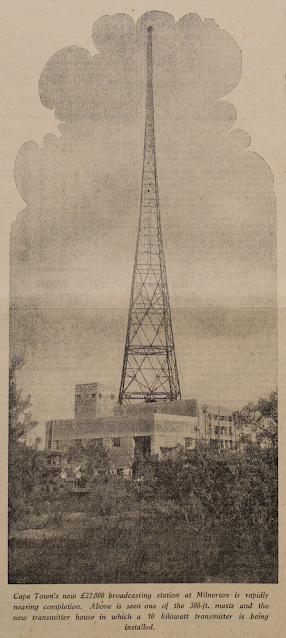
Cape Town’s new £22 000 Broadcasting Station at Milnerton

 CAPE TIMES - 1933, July 18 The Cape and Peninsula Broadcasting Association started Cape Town’s first Broadcasting Station on September 15, ...