Showing posts with label Berlin. Show all posts

Monday, 30 January 2023

Eight-wheel Car (ADLER Diplomat)

 THE STAR Johannesburg - 1935, August 16

A Berlin firm has produced an eight-wheel car, said to be virtually shock-proof and comfortable over rough roads at high speeds. The photograph shows the new car on a country road. 

The position of the front wheel illustrates how the car will avoid bumping. The wheels will pass over the holes in the road, and not into them.


Read more about the 1935 ADLER Diplomat 8 Wheels at 
https://www.vintag.es/2020/10/1935-adler-diplomat.html


Monday, 6 July 2020

MAXIM High Grade Clothing


THE STAR Johannesburg - 1920, July 6 & 20
THE STAR Johannesburg - 1920, July 6
Sir Robert Horne, the President of the Board of Trade, says that next winter worsted suits of the best quality will cost 20 guineas, but, much to the relief of the average man, he adds that clothes of good and sound quality will be obtainable at lower prices. 
In New York, a suit of best quality British-made cloth costs £60, in Paris £52 10s., Berlin £200 and Montreal £35.
We bought heavily twelve months ago, when many others were afraid. Consequently, today we are able to offer exceptional values in tailoring.
Lounge suits from 11 Guineas available in 3 Johannesburg Shops.
THE STAR Johannesburg - 1920, July 20


Can you afford to disregard your appearance? Think it over carefully. A well-dressed man commands immediate attention, and this attention often provides the first step toward success.
You are cordially invited to inspect the latest designs in Glen Urquhart Checks at 3 MAXIM shops in Johannesburg. The Sauer’s Buildings Branch will remain open on Wednesday Afternoons.

Thursday, 30 January 2020

How the S.O.S. Call Originated


CAPE TIMES - 1924, May 27
The origin of the distress signal of ships at sea, now familiar to most people, has always caused considerable curiosity. The first suggestion of a distress call for ships was made by the Italian delegates at an early conference on wireless telegraphy, held in Berlin in 1903. These delegates urged the adoption of a universal signal, “SSSDDD,” to be sent by ships in distress. Shore stations and other ships, upon picking up such a signal would then stand by for further messages and suspend other communication immediately.
The final decision to adopt such a signal, however, was left to a special conference, but before anything came of it the Marconi Company, recognizing the need for a distress call, instituted on February 1, 1904, by general order, the famous call, “CQD,” on all their ships. This signal was a combination of the general call “CQ” coupled with the letter “D” to signify distress.
Only by the order of the captain of a ship in distress could it be used, or by a station retransmitting the signal. All stations were to recognize the urgency of the call and make every effort to establish satisfactory communication without delay. Several countries, including the United States, adopted “CQD,” and used it until the Berlin regulations were ratified.
A GERMAN SUGGESTION

At the Radio Telegraph Conference held in Berlin in 1906, the German government submitted a suggestion “that the ships in distressed will make use of the following special danger signal: . . . ― ― ― . . . (SOS).
Previously, German ships desiring to communicate with all vessels in their proximity, without knowing the names of calls, would send an inquiry signal, “SOE.” Germany planned to suggest this signal as the international signal, but as the last letter “E” represented in Morse by a single dot, was not believed sufficiently characteristic, the delegates in 1906 suggested the final letter as “S,” thereby having the honour to define what became the universal signal.
Whilst interpretations such as “Save Our Souls” and “Save Our Ship” should be accepted with reserve, there is this about it, that if these interpretations are not true, they are cleverly invented. In a similar manner the literal translations offered for “CQD” were
Come Quickly, Do,” and “Come Quick! Danger!”
The distress signal “SOS” was adopted officially and put into effect by the International Radiotelegraphic Convention of Berlin in July, 1908.
It was naturally a matter of keen regret to the Marconi operation that their old signal “CQD” was not adopted, and many continued to send “CQD” as well as “SOS” when accidents occurred. “CQD,” however, was gradually forgotten. In 1912 the USA adopted “SOS” when the international agreement was accepted.
It is pointed out that the signal today is “SOS” without space. The Morse man will readily understand the difference. 

Thursday, 26 December 2019

Herr Adolf Hitler at a Christmas Party


THE STAR Johannesburg - 1938, January 4
An unconventional picture of Herr Hitler at a Christmas party in Berlin. On the left is Herr Philipp Bouhler, Reich Leader and Chief of the National Socialist Party Chancellery, and on the right Herr Hederich.


Thursday, 6 June 2019

PHILIPS Home Radio and Multi-Inductance All-World Receivers

CAPE TIMES - April 4, 1933


The Philips Company was founded in Eindhoven in 1891, by Gerard Philips and his father Frederik Philips, where the company started the production of carbon-filament lamps and other electro-technical products in 1892. This first factory is used as a museum.
The family business began to expand rapidly and they laid the foundations for the later electronics multinational.

1908
- founding of Philips Metal Filament Lamp Factory Ltd. in Eindhoven
1912
- foundation of Philips Lightbulb Factories Ltd.
1920s
- the company started to manufacture other products, e.g. vacuum tubes
1930s
- the "Chapel" (a radio with built-in loudspeaker) was designed
1939
- introduced the Philishave – an electric razor


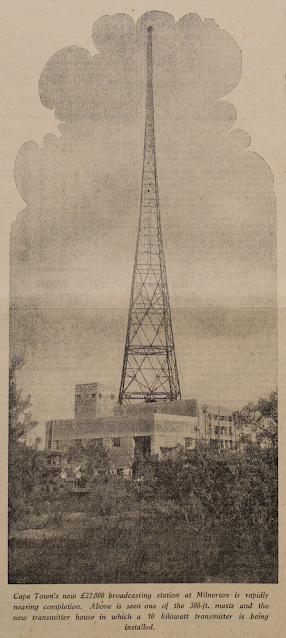
Cape Town’s new £22 000 Broadcasting Station at Milnerton

 CAPE TIMES - 1933, July 18 The Cape and Peninsula Broadcasting Association started Cape Town’s first Broadcasting Station on September 15, ...