Showing posts with label Germany. Show all posts

Thursday, 30 January 2020

How the S.O.S. Call Originated


CAPE TIMES - 1924, May 27
The origin of the distress signal of ships at sea, now familiar to most people, has always caused considerable curiosity. The first suggestion of a distress call for ships was made by the Italian delegates at an early conference on wireless telegraphy, held in Berlin in 1903. These delegates urged the adoption of a universal signal, “SSSDDD,” to be sent by ships in distress. Shore stations and other ships, upon picking up such a signal would then stand by for further messages and suspend other communication immediately.
The final decision to adopt such a signal, however, was left to a special conference, but before anything came of it the Marconi Company, recognizing the need for a distress call, instituted on February 1, 1904, by general order, the famous call, “CQD,” on all their ships. This signal was a combination of the general call “CQ” coupled with the letter “D” to signify distress.
Only by the order of the captain of a ship in distress could it be used, or by a station retransmitting the signal. All stations were to recognize the urgency of the call and make every effort to establish satisfactory communication without delay. Several countries, including the United States, adopted “CQD,” and used it until the Berlin regulations were ratified.
A GERMAN SUGGESTION

At the Radio Telegraph Conference held in Berlin in 1906, the German government submitted a suggestion “that the ships in distressed will make use of the following special danger signal: . . . ― ― ― . . . (SOS).
Previously, German ships desiring to communicate with all vessels in their proximity, without knowing the names of calls, would send an inquiry signal, “SOE.” Germany planned to suggest this signal as the international signal, but as the last letter “E” represented in Morse by a single dot, was not believed sufficiently characteristic, the delegates in 1906 suggested the final letter as “S,” thereby having the honour to define what became the universal signal.
Whilst interpretations such as “Save Our Souls” and “Save Our Ship” should be accepted with reserve, there is this about it, that if these interpretations are not true, they are cleverly invented. In a similar manner the literal translations offered for “CQD” were
Come Quickly, Do,” and “Come Quick! Danger!”
The distress signal “SOS” was adopted officially and put into effect by the International Radiotelegraphic Convention of Berlin in July, 1908.
It was naturally a matter of keen regret to the Marconi operation that their old signal “CQD” was not adopted, and many continued to send “CQD” as well as “SOS” when accidents occurred. “CQD,” however, was gradually forgotten. In 1912 the USA adopted “SOS” when the international agreement was accepted.
It is pointed out that the signal today is “SOS” without space. The Morse man will readily understand the difference. 

Thursday, 26 December 2019

Herr Adolf Hitler at a Christmas Party


THE STAR Johannesburg - 1938, January 4
An unconventional picture of Herr Hitler at a Christmas party in Berlin. On the left is Herr Philipp Bouhler, Reich Leader and Chief of the National Socialist Party Chancellery, and on the right Herr Hederich.


A Strange Christmas - Friend & Foe Fraternise


CAPE ARGUS – 1915, January 1 & 2
That Christmas in the trenches was not all fighting appears from a letter sent home by a private in the Queen’s Westminsters. The writer says:
“Christmas in the trenches was the funniest thing I ever struck. Our guns shelled the German trenches till 4 o’clock on Christmas Eve, and then there was a little rifle fire till dark, when we started singing carols and songs and chaffing the enemy. As things were apparently going very well, four of us got on top of a parapet and struck matches. The enemy cheered, so we all got out and held a concert and dance in the open. We hailed the enemy, met a few half-way, shook hands and exchanged cigarettes. They are jolly good sports. We had a football on Christmas Day, and asked the Germans to send a team, but they declined the challenge. Anyhow, we had a friendly chat. One of the Germans produced a camera and photographed a group of twelve Westminsters and twelve Germans. I smoked German cigars all day and ate German chocolates all night while on guard, so did not do so badly.”
Fuller details are now available of the truce which prevailed on Christmas Day between the British and German soldiers on many parts of the British front. These show that this truce was one of the most impressive events of the war. Soldiers crossed, met each other and shook hands, sang glees and hymns together and exchanged cigars, chocolates, etc. Neither side had believed such peace and goodwill possible. British officers and men declare they never spent a happier day. German officers were most affable and exchanged tokens.
On Christmas Eve the Germans shouted to the Englishmen, “Sing to us.” The response was the singing of “Lead, Kindly Light” and “Abide with me.” In fact, great enthusiasm for the time being prevailed among friend and foe, who even went to the length of playing games together. It was noteworthy that the trucemakers appeared to be Saxons, and not Prussians. 

Saturday, 9 November 2019

Wine Exports to Sweden


CAPE TIMES – 1933, August 8
Sweden’s increased imports of South African Wines, referred to by the Union Trade Commissioner in Sweden, are attributed by the K.W.V. officials to the fact that South Africa has concentrated on supplying genuine wines of the Cap Constantia type.
Germany had for many years exported large quantities of wine, known as Cap Constantia, to Sweden one of the officials told the Paarl representative of the Cape Times yesterday. This variety, however, was a concoction of cheap Continental wines mixed with a small blend of South African Cap Constantia.
As the result of a report received by the K.W.V. from the Union Trade Commissioner in Great Britain, the K.W.V. had concentrated on supplying the genuine article direct to Sweden. This South African wine had no difficulty in ousting the Continental brands, and the Union’s exports increased last year by 365 percent, while the German wine manufacturers and exporters had lost 45 percent of their wine trade with Sweden.
STILL EXPANDING
Whereas German exported 86 229 litres to Sweden in 1931, this figure dropped to 47 587 litres that year. On the other hand, South African exports to that country increased of 1 litre, or .22 gallons a day.
Although this was only the K.W.V.’s second year of export to Sweden, the market had assumed large dimensions and was still expanding. South Africa now ranks third on the list of wine exporters to Sweden. Portugal still leads with an export of 1 588 864 litres while Spain is the runner-up with 413 229 litres.
The Portuguese exports to Sweden have, however, diminished by 36 percent, while the Spanish trade has suffered a decrease export of 30 percent. The only other country, besides South Africa, that showed an increased export of wines to Sweden was Italy, who last year consigned and sold 40 percent more wine on the Swedish market than during 1931.
The wine exports from Greece to Sweden in 1932 decreased by 63 percent. The French market in in Sweden showed the lowest decrease, of only 2 percent.

Read more about the Press Release: Wines of South Africa Export Report 2018 
at   https://www.wosa.co.za/Wosa-News/Press-Releases/2019/Press-Release--Export-Report/

Thursday, 31 October 2019

American Airship Disaster

CAPE TIMES - 1933, April 5

Disaster has befallen the Akron, greatest airship in the world and pride of the United States Navy. She is believed to have been struck by lightning during the night off the New Jersey coast. At any rate she crashed into the sea with 77 officers and men aboard and sank, after drifting for some hours, a hopeless wreck. So far, one officer and three men have been rescued, and one of these, the wireless operator, has since died.


THE STAR Johannesburg - 1933, April 4
The world’s largest airship, the United States naval dirigible AKRON, is reported to be a wreck off the New Jersey coast. Naval officials believe the airship was struck by lightning. Admiral WA Moffett, Rear-Admiral Berry and Rear-Admiral Cecil, the last 2 commanding officers of the Naval Air station, are among the complement of 19 officers and 57 men on board. Only the chief officer, Commander Wiley, and 3 of the crew are known to have been saved, and the Lakehurst Naval Station telephones that chances of saving the remainder are slight.
THE LAST RADIO MESSAGE
The last wireless communication with the Akron was at 10 o’clock last night, since when thunderstorms have interfered with messages. The Akron landed in the sea near the Barnegat lightship, and a German tanker, the Phoebus, was the first on the scene. The Phoebus rescued the chief officer and 3 of the crew, but the master thinks the remainder were lost. Four coastguard vessels, a cruiser, a destroyer and all craft in the vicinity are rushing to the scene of the disaster, where the wreck of the airship is reported to be afloat still. It is impossible to send an aeroplane owing to a “ceiling” of only 300ft and bad visibility.
Admiral WA Moffett has been the driving force behind America’s enthusiasm for lighter than air craft. From the day when the 2R3, given to America under the reparations agreement, made her historic trip across the Atlantic from Germany, Admiral Moffett has been an advocate of airships as the dreadnought of the skies.
The Akron expressed his ideal, for it had an armament of 16 guns and carried 5 aeroplanes inside the hull. These were equipped for screening the dirigible with smoke or for concerted attacks on enemy warships. The Akron, or ZRS4, was given into the charge of the United States Navy by its constructors, the Goodyear-Zeppelin Company, on August 8, 1931, and the occasion was one of great national rejoicing.
HUGE CAPACITY
The Akron was only a few feet longer than the German giant, the Graf Zeppelin, but it had a gas capacity of 6 500 000 cubic feet, or almost twice that of the Graf Zeppelin. It had a diameter of 133 feet and a lift capacity of 91 tons. The use of helium which is non-inflammable and non-explosive, permitted the incorporation of several new features. Former airships found it necessary to house their engines in gondolas suspended away from the hull itself to avoid the danger of explosion, but the Akron’s eight motors were housed inside the hull, which reduces parasite drag to a minimum. The Akron was 785 ft. in length and the frame of the vessel was made of duralumin to provide lightness and strength. There were 10 000 000 individual numbered parts, 54 000 tiny flat braces and 6 500 000 rivets. The deadweight of the airship empty was about 100 tons.
SEVENTH DISASTER
The crash of the Akron makes the seventh airship disaster since 1921, states the London correspondent of The Star. In February of that year the American dirigible, Roma, exploded at Hampton, Virginia, and 34 people died of injuries. On August 24, 1921, the ZR2 collapsed and exploded over Hull and 42 were killed. The French airship, Dixmude, German-built, was mysteriously lost in a gale with 30 men on board in 1923. The American airship, Shenandoah collapsed in a thunderstorm on September 3, 1925, and 14 were killed. On May 25, 1928, General Nobile’s airship, the Italia, crashed at North Spitzbergen and 14 were killed, and 3 would-be rescuers also lost their lives. 3 years ago, the British airship R101 exploded at Beauvais, France, and 46 were killed.
CAUGHT IN STORM
In May, 1932, the Akron fought a terrific battle with a storm over California, and when attempting to land afterwards broke 3 times from the moorings. 3 youths were hauled into the air clinging to the mooring ropes. 2 fell 200 feet and were killed. The other was rescued after dangling in the air for 3 hours.
REPORT BY MASTER OF THE PHOEBUS
Latest messages received from the German tanker Phoebus indicates that most of the crew of the Akron are lost. The Master of the Phoebus describes how he found mattresses and wreckage floating on the water. He rescued 3 men and saw 3 other men sink before his rescue party could reach them. He describes a thunderstorm and lightning, which might have struck the Akron. He suddenly caught a glimpse of the aircraft with her lights flashing on the water, and he heard men hailing him.
He turned on all the ship’s lights and put out lifeboats towards the dimly discernible lumps of the wreckage. Reuter, New York


More interesting facts about the USS Akron:
The USS Akron was commissioned in October 1931 and had its maiden voyage on November 2, 1931. During a full-blown thunderstorm during the night of April 3-4, 1933, the ship crashed into the stormy Atlantic. Sadly, of the 76 people on-board, most had died of exposure or drowning in the turbulent and freezing cold sea. Incredibly, the Akron had not been equipped with life jackets.
The role of the Akron was to scout for enemy ships and submarines.
It was 785 feet long - over 3 times longer than a Boeing 747 airliner.
Nearly seven and half million cubic feet of volume was displaced.
It had four starboard propellers and the engines’ water reclaiming devices appear as white strips above each propeller.
The emergency rear control cabin was visible in the lower fin.
It could carry up to five small fighter-reconnaissance aircraft.
The plane was launched and retrieved via a trapeze-style mechanism.
Bristled with 8 heavy machine guns, it had a crew of 60.
Range of nearly 7,000 miles. 
With a top speed of 79 miles per hour, it was twice as fast as the latest American Lexington-class aircraft carriers.

Saturday, 12 October 2019

Cape Wool Export


CAPE TIMES - 1924, April 8
On a business and pleasure trip, Mr. JM Gilfillan, of Gilfillan & Page Ltd., a big London firm of wool importers, arrived by the Armadale Castle yesterday. Interviewed by a representative of the “Cape Times” on the wool position in Europe, Mr. Gilfillan said that all grades of wool were in a strong future; while the financial position of the wool trade, about which fears were entertained in the latter part of last year, no longer gave rise for any uneasiness. In spite of the high prices now being paid for all classes of wool traders and manufacturers seemed well able to finance their obligations. “During the past season,” he continued, “a fair quantity of better class Cape wools have been catalogued at the London auction sales, and these have commanded high prices. The grading and breeding of your wools of late years, I must say, mark a noticeable advance; and it is quite evident that if the farmers continue to put back into bloodstock a proportion of the high prices they are getting, then the prestige of South African wool on the European markets will indeed rise to a very high point.”
CONDITIONS IN GERMANY
Asked with regard to the position of Germany as a buyer, Mr. Gilfillan replied that economic conditions in that country had become much more settled since the advent of the Renten mark; and although everything at present was excessively dear, the uncertainty brought about by the wild fluctuations of the old Reichsmark was disappearing; and trade was assuming more normal conditions.
Nevertheless, he added, the great bulk of German traders and manufacturers had not yet regained full confidence in the new currency, for Amsterdam and London still held in their respective currencies a vast proportion of Germany’s trading capital.
“For wool in particular,” continued Mr. Gilfillan, “the German demand is enormous, particularly in the classes produced by South Africa and Australia, which are the most suitable for their trade. For these wools, all through last season, they have been paying enormous prices, defying all competition from France and Bradford, paying cash down in English money, and wanting to keep their mills running. Nobody can stand up against them.”

At a Wool Sale in Cape Town in October 1939, 3 312 bales were offered. Mr. W. Young, chairman of the Cape Town Wool Exchange, stated that the market was firmer and the competition keener, especially from American and Japanese interests.
(CAPE ARGUS - 1939, October 30) 


Read more about the crisis Wool Producers had to face earlier this year, and how this problem has been solved.

Monday, 9 September 2019

First Penguins in Cape Town

CAPE ARGUS – 1939, March 6 & 15

The first Emperor Penguins ever seen in Cape Town arrived aboard the German vessel Schwabenland from the frozen South. Photographed with them is their “keeper”, Mr. E. Barkley who hoped to deliver them to the Hamburg Zoo.


Shortly after these penguins left Cape Town, a Golden Crest Penguin was found in the Cape Docks and a home was sought for this penguin.
WHO WANTS A PENGUIN?
One of the Golden Crest variety was found in the Cape docks by Mr. R. Charter, of the Division of Fisheries. At first, he thought it was the penguin which “deserted” from the American freighter West Isleta. A number of Jackass penguins were sent to the World Fair in this ship, but one slipped away before the vessel cleared and has not yet been found.
The penguin is about 14 inches high and has two golden “eyebrows,” the distinctive mark of the variety. Mr. Charter then thought the penguin might have escaped from the German ship Schwabenland, which had on board several Emperor and Adelie penguins, which it brought from the Antarctic and is taking to Germany. The Emperor penguins were the first of their kind ever to be seen in Cape Town.
According to inquiries made by Mr. Charter at the South African Museum, the Golden Crest penguin must have come from the Antarctic where they are to be found in large numbers. It is the only one in the Union at present.
It is thought that the penguin may have come in one of the whaling ships, but so far no one has come forward to solve the solution of how this Arctic bird arrived in Cape Town docks.
Today the penguin was taken to Mr. Charter’s home for the weekend. But he is not anxious to keep it and will gladly give it to anyone who wants it.

Thursday, 15 August 2019

Folding Canoe & other interesting inventions

CAPE TIMES - 1933, July 18
CAPE ARGUS – 1951, November 3
Folding Canoe

This canoe folds up to fit into a rucksack. It weighs 6 pounds and is 15.5 feet.
Years later, an  Israeli designer for Tsor Design Studios, ORI LEVIN, created a Folding Canoe, the ADHOC, that assembled in about 5 minutes and weighed only 4.1 kg.


At an International Exhibition in Frankfurt, Germany, were a Three-Wheeler Light Car (top speed 31 m.p.h.) and an ultra-lightweight auto-cycle with a 49 cc. engine.
(CAPE ARGUS – 1951, November 3)


This is a model of a new design, evolved in Russia, for high-speed water travel. It consists of two hydro-plane hulls carrying the promenade decks between them, the cabins in the hulls, and the bridge in a little tower on the “roof”. A boat of this description would, the designers consider, cruise cheaply at over 40 miles an hour.

(CAPE ARGUS – 1951, November 3)


Monday, 12 August 2019

The "RUNAWAY PLANET" - OBJECT REINMUTH (HERMES)

THE STAR Johannesburg - 1938, 10 January 

The German astronomer, KARL REINMUTH, discovered “THE RUNAWAY PLANET” in 1937 when it zipped past Earth at about 800,000 km, just twice the distance to the moon. Unfortunately, astronomers lost sight before they could precisely determine its orbit. “THE RUNAWAY PLANET” - OBJECT REINMUTH 1937 UB (O.R. for short) missed the earth by 5½ hours on October 30, 1937. On 10 January 1938 THE STAR Johannesburg reported that Cape Town astronomers, Dr. H.E. Wood and Mr. Arthur W. Long, predicted that O.R. may be coming back in a few years’ time. The asteroid was named after the swift messenger god of the ancient Greeks, HERMES. 
After 66 years, on 15 October 2003, this kilometre-wide asteroid became visible again and the new orbit was firmly linked to the scant observations of 1937. Relieved astronomers announced that the potential killer rock will not get uncomfortably close to Earth within the next century. They predicted that HERMES will make its closest approach to Earth on 4 Nov. 2003, at a safe distance of 7 million km. They expect that it won't get any closer than about 3 million km within the next hundred years or so. According to astronomers it is hard to predict what will happen in the distant future, as HERMES seems to be very eccentric. At least HERMES won't get lost again, thanks to the new observations. 

(Additional info taken from an article by Govert Schilling:


Tuesday, 23 July 2019

Taking off One's Clothes

CAPE TIMES - 1933, 19 July


Miss JAN GAY, a young American, did the Grand Tour of the European Nudist Colonies in 1933.
GR Stevens reviewed ON GOING NAKED, Miss Gay’s book on the Ethics and Aesthetics of taking off one’s clothes.
Not fewer than 134 nudist colonies in Germany were listed where members might be as naked as the liked in parks or secluded retreats. Some were physical culture clubs, while others taught dancing or eurythmics. Sometimes Vegetarianism or similar practices were combined with nakedness. A few colonies were economic in intention, living and working under strict communism.
Miss Gay did not throw any particular light on the motives which underlie nudism. Various aspects – sensuous, aesthetic, ethical and economic – were jumbled up in her mind, and she justified an aesthetic objection with an economic argument.
Her personal impulses were sensuous, as she had always loved sunlight and rain, wind and the cool of evenings on her skin. This was an admirable reason for taking off her clothes. She proved that there was something to be said for nudism on a number of counts, and that as a movement it possesses a certain significance.
The aesthetic argument, like the sensuous argument, was self-evident. To her, clothes were ugly compared with beautiful bodies, but she admitted that all bodies are not beautiful.
The ethical aspects were controversial. It seemed possible that there might be some advantages in a naked society and that there was a basis for the German contention that nudism was an antidote to sexual promiscuity, a corrective for the over-sexing engendered by the hiving in cities and a better preparation for satisfactory mating than the conventional artificial courtship.
On economic grounds nudism was no more than a minor offshoot of Communism, of little importance until Jack Frost would become a proletarian. At that stage, he nipped Communists and Capitalists alike, and the best of theories had to suffer if they involved chilblains.

Sunday, 14 July 2019

The Battle of Delville Wood 1916

CAPE TIMES – July 15 & 17, 1933
BOIS D’ELVILLE (9 miles from Albert near the commune of Longueval, in the Somme department of France) was a major German defensive feature. The South African Brigade was attached to the 9th Scottish Division to capture the wood in July 1916. The South African regiment (consisting of some 3,150 men) went in at dawn on 15 July. Following a heavy artillery battle, the southern edge of German forces was cleared. The remainder of the wood was still in German hands. Fighting hard, the South Africans were relieved on the night of 19 July – among the four battalions 766 men were lost. The surrounding landscape was left with broken stumps, tree roots and massive shell holes. Bodies of South African and German forces were covered by mud and rainwater. This Battle at Delville Wood was the most costly action the South African Brigade fought on the Western Front. In 1920 South Africa bought this site as a memorial to those of that nation who fell, not just here but elsewhere. The memorial was designed by Sir Herbert Baker, assistant architect was Arthur James Scott Hutton, with sculpture by Alfred Turner. 
Inscription: To the Immortal Dead from South Africa, who at the call of Duty made the Great Sacrifice on the battlefields of Africa, Asia and Europe. 


You are welcome to read more about this battle at

Monday, 27 May 2019

The "RUNAWAY PLANET" - OBJECT REINMUTH (HERMES)

THE STAR Johannesburg - 1938, 10 January 
The German astronomer, KARL REINMUTH, discovered “THE RUNAWAY PLANET” in 1937 when it zipped past Earth at about 800,000 km, just twice the distance to the moon. Unfortunately, astronomers lost sight before they could precisely determine its orbit. “THE RUNAWAY PLANET” - OBJECT REINMUTH 1937 UB (O.R. for short) missed the earth by 5½ hours on October 30, 1937. On 10 January 1938 THE STAR Johannesburg reported that Cape Town astronomers, Dr. H.E. Wood and Mr. Arthur W. Long, predicted that O.R. may be coming back in a few years’ time. The asteroid was named after the swift messenger god of the ancient Greeks, HERMES. 
After 66 years, on 15 October 2003, this kilometre-wide asteroid became visible again and the new orbit was firmly linked to the scant observations of 1937. Relieved astronomers announced that the potential killer rock will not get uncomfortably close to Earth within the next century. They predicted that HERMES will make its closest approach to Earth on 4 Nov. 2003, at a safe distance of 7 million km. They expect that it won't get any closer than about 3 million km within the next hundred years or so. According to astronomers it is hard to predict what will happen in the distant future, as HERMES seems to be very eccentric. At least HERMES won't get lost again, thanks to the new observations. 
(Additional info taken from an article by Govert Schilling, Oct. 17, 2003 - https://www.sciencemag.org)

Monday, 29 April 2019

Launching of the GRAF SPEE - Germany's Third "Pocket Battleship"

CAPE TIMES - July19, 1934
The GRAF SPEE, Germany's Third "Pocket Battleship" was launched on 30 June 1934. At her launching, she was christened by the daughter of Admiral Maximilian von Spee, the ship's namesake. She was completed slightly over a year and a half later on 6 January 1936, the day she was commissioned into the German fleet.
The term "Pocket Battleship" refers to any of a class of cruisers with large-calibre guns, operated by the German navy in the Second World War.

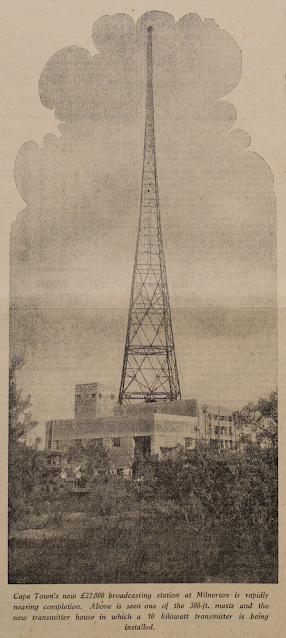
Cape Town’s new £22 000 Broadcasting Station at Milnerton

 CAPE TIMES - 1933, July 18 The Cape and Peninsula Broadcasting Association started Cape Town’s first Broadcasting Station on September 15, ...