Showing posts with label Great Britain. Show all posts

Saturday, 9 November 2019

Wine Exports to Sweden


CAPE TIMES – 1933, August 8
Sweden’s increased imports of South African Wines, referred to by the Union Trade Commissioner in Sweden, are attributed by the K.W.V. officials to the fact that South Africa has concentrated on supplying genuine wines of the Cap Constantia type.
Germany had for many years exported large quantities of wine, known as Cap Constantia, to Sweden one of the officials told the Paarl representative of the Cape Times yesterday. This variety, however, was a concoction of cheap Continental wines mixed with a small blend of South African Cap Constantia.
As the result of a report received by the K.W.V. from the Union Trade Commissioner in Great Britain, the K.W.V. had concentrated on supplying the genuine article direct to Sweden. This South African wine had no difficulty in ousting the Continental brands, and the Union’s exports increased last year by 365 percent, while the German wine manufacturers and exporters had lost 45 percent of their wine trade with Sweden.
STILL EXPANDING
Whereas German exported 86 229 litres to Sweden in 1931, this figure dropped to 47 587 litres that year. On the other hand, South African exports to that country increased of 1 litre, or .22 gallons a day.
Although this was only the K.W.V.’s second year of export to Sweden, the market had assumed large dimensions and was still expanding. South Africa now ranks third on the list of wine exporters to Sweden. Portugal still leads with an export of 1 588 864 litres while Spain is the runner-up with 413 229 litres.
The Portuguese exports to Sweden have, however, diminished by 36 percent, while the Spanish trade has suffered a decrease export of 30 percent. The only other country, besides South Africa, that showed an increased export of wines to Sweden was Italy, who last year consigned and sold 40 percent more wine on the Swedish market than during 1931.
The wine exports from Greece to Sweden in 1932 decreased by 63 percent. The French market in in Sweden showed the lowest decrease, of only 2 percent.

Read more about the Press Release: Wines of South Africa Export Report 2018 
at   https://www.wosa.co.za/Wosa-News/Press-Releases/2019/Press-Release--Export-Report/

Wednesday, 28 August 2019

Advertising as a Career

CAPE TIMES – 1928, July 19

Important Posts Held by women
Of the many fields for women’s work which have developed in recent years that of advertising offers the widest scope and makes the most picturesque appeal. It is work for which the woman’s mind has an advantage over the mentality of the male. Advertising authorities, pointing to America and Great Britain, where many women in the advertising field now earn from £500 to £2,500 a year, agree that unparalleled opportunities in this profession are waiting to be seized by women in this country. There is a league in New York called “The League of Advertising Women,” and both London and New York have their Women’s Advertising Clubs. There is probably no profession in which the percentage of women holding responsible positions is so high as it is in advertising. This is no doubt largely due to the fact that it is of comparatively modern growth and women have not had to overcome prejudices that are deep rooted in tradition to the extent they have in some other professions.
There are many women directors of advertising agencies, at least two of whom have been in the business for 30 years or more and have advanced by the weight of great ability form subordinate positions to administrative posts, and in one case, to the chairmanship of a great advertising organisation. The most notable example is Miss. J. R. Reynolds, F.I.P.A., who arrived in Wellington this week.
A considerable number of the important posts in the advertising departments of the British newspapers and periodicals are held by women, including the coveted one of advertisement manager to London “Punch,” who rose to power because she believed in advertising, started her career as a copywriter on the staff of a London advertising agency. A large advertising firm in London has four women on its copy-writing staff, and one of its three commercial studios is staffed entirely by women. One of Sydney’s largest department stores has placed its advertising in charge of a woman. The advertising department of the “Queensland Country Press” is represented in Sydney by Miss Foote.
Appeal to Women
A factor that has had a considerable influence in providing their openings for women is that the bulk of advertising directs its appeal to women. One of the speakers at a British convention luncheon, at which a woman was in the chair, and for which the details were arranged by women in advertising businesses, emphasized the fact that 90 percent of the buying – not trading – in the world is done by women, and 75 percent of the shops in Regent and Oxford Streets, London, are for women alone. She quoted figures from an Oxford Street store which showed that 75 000 women each day passed in and out of the doors, inspecting goods or making purchases. The psychological effects of advertising are admittedly a highly important branch of study, and therefore the instinctive desire to bring women, into the profession, is thoroughly sound. A woman’s mind. With its love of detail and its big imagination, can appeal to prospective women customers better than the average man’s. 
The three chief branches of advertising offering wide scope to the woman expert are: 
(1) Advertising Management: the organization for business concerns of the advertising systems by which they aim to sell their goods. 
(2) Advertising Agency: the preparation and placing of advertisements and the organization of selling-schemes for trade advertisers. 
(3) Advertisement Management or the Organisation of Newspaper and Magazine Advertising. The sale of space by canvassing is an important feature of this branch of work.
For Clever Women 
Advertising is undoubtedly a profession in which a clever woman can secure big prizes. But it must not be thought that these prizes are lucky windfalls. They are the result of rigorous training, patient endeavor, and grueling work. One starts early, finishes late and when emergencies arise, burns a lot of midnight oil. But withal it is a fascinating business – curiously enthralling. It needs skill of a high order to put the facts of an advertisement in a form that will capture the imagination, and sway the buying moods of tens of thousands of people. It is work that gives a gratifying feeling of power and, being important work, it rightly commands high salaries. – “The Dominion” (New Zealand).


Friday, 23 August 2019

Nursing as a Career


Cape Argus – 1939, February 27
The profession of nursing, which was until comparatively recent times one of the few to which women who wanted a career could turn, has of late attracted an alarmingly small number of recruits. The reasons for this state of affairs are many, but perhaps the most important one is that, judged by the standard of most other professions, the conditions in which nursing is done are unsatisfactory and advancement is slow, but not very sure. In other words, hard work and little pay do not attract anybody but the girl who feels that she has a vocation and who is willing to give disinterested service in fulfillment of it. However, reforms are now being made in various directions and the nurses of the future should have a little cause for complaint.

To encourage the recruitment of young women as nurses, a monster meeting was held in London. Queen Mary, Princess Alice and the Earl of Athlone attended it and the Archbishop of Canterbury presided. In the audience were senior girls from schools all over the country and members of various youth organisations. Previously they had been taken over several London hospitals so that they could see something in the conditions in which nurses work and live.
The Archbishop read to the meeting a message given by Queen Mary in which she said:
“Certainly, now more than ever willing helpers are needed in the sacred cause of preventing ill-health, of securing the safety of motherhood, and of relieving sickness and pain. I appeal to the girls of the country to ask themselves whether they may not find in this profession not only a career of interest and usefulness but one of the truest and noblest forms of national service.” Her Majesty’s words, said the Archbishop, admirably summarized the purpose of the meeting. Referring to the report recently made by the Inter-departmental Committee on the Nursing Services over which Lord Athlone presided, he hoped that it would result in the removal of all reasonable grounds for dissatisfaction. He stressed, however, the fact, as did each of the other speakers, that nursing is a career which still demands a sense of vocation.
Miss Reynolds, matron of the London Hospital, suggested that women of teaching ability were sorely needed in the nursing profession, as sister tutors for the theoretical instruction of student nurses, or as dieticians; as ward sisters; as industrial nurses in factories and as district and public health nurses. For the ambitions, she concluded, there was unlimited scope in the profession of nursing.
The report of the Interdepartmental Committee on Nursing Services to which reference was made at the meeting was largely the work of the joint secretaries Sir Weldon Dalrymple-Champneys and Mr. W.A.B.M. Hamilton.
“To their energy and enterprise,” noted the committee headed by Lord Athlone, “we largely owe the immense amount of valuable information placed before us, while the co-ordination of as much complex detail is a tribute to their skill.”
Sir Weldon Dalrymple-Champneys, Bt., an official in the British Ministry of Health, was in Cape Town two years ago when he collected Button Spiders for a particular piece of scientific investigation in which he was engaged.
His interest in the medical health of the nation is hereditary. His father, the late Sir Francis Champneys, obtained the first charter for midwives in Great Britain (the first Midwives Act).
For some time Sir Weldon has been investigating the shortage of nurses in Great Britain and looking into the working conditions which seem to make nursing unattractive to young women. As a result of his committee’s report hospital conditions are likely to be greatly improved from the nurse’s point of view.

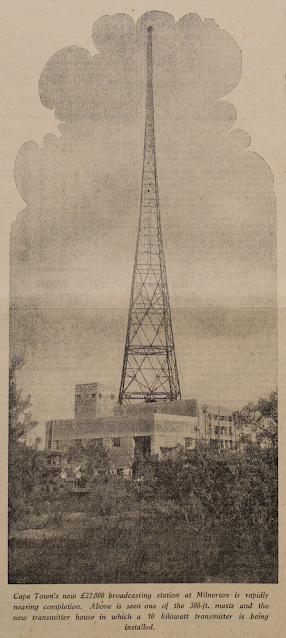
Cape Town’s new £22 000 Broadcasting Station at Milnerton

 CAPE TIMES - 1933, July 18 The Cape and Peninsula Broadcasting Association started Cape Town’s first Broadcasting Station on September 15, ...