Showing posts with label Britain. Show all posts

Monday, 3 August 2020

Broadcasting in Cape Town in 1924


CAPE TIMES - 1924, April 24

The arrangement made by the Broadcasting Committee whereby the Cape Peninsula Publicity Association should take over the license to broadcast from Cape Town was confirmed at a well-attended meeting. Mr. J. S. Dunn was re-elected chairman of the Association, and Dr. Bennie Hewat was appointed vice-chairman.
Amongst the chief recommendations was the ratification of the agreement to take over the broadcasting license transferred by the Graaff Trust, and a proposal to send Mr. A. N. Dickson to England to complete arrangements for the acquisition of an up-to-date transmitter and the necessary technical staff for running the service. He will make himself acquainted with the methods of the British Broadcasting Company, and is due back on June 16, bringing out the whole apparatus and technical staff with him. He hopes to have everything fixed up for actual broadcasting to commence in Cape Town on the occasion of the Orchestra Ball on Wednesday, July 16.
The situation of the transmitting station is uncertain at the moment. The technical expert of the Association is strongly inclined to recommend the erection of the transmitter on the Flats to avoid any possible chance of “screening” from surrounding buildings. The studio will be located somewhere in the centre of the city, with connections to the broadcasting station made by land lines.


CAPE TIMES - 1924, April 26
Interviewed by Reuter’s on the eve of his departure for England, Mr. A. N. Dickson, secretary of the Cape Town Peninsula Publicity Association and business manager of the Cape Town Orchestra, said that the announcement of the Publicity Association taking over the broadcasting license for the Cape area had given general satisfaction.
Mr. Dickson said that the two main objects for his visit overseas were to negotiate the purchase of a transmitting set on the best possible terms, and to study the working of the BBC’s station in London.

In conclusion, he smilingly added: “We are sometimes accused of moving slowly in Cape Town, but in this case we have simply jumped.”


CAPE TIMES - 1933, July 17
CAPE TIMES - 1933, July 18


Putting the finishing touches to the Transmitting Panel of Cape Town’s new £22,000 high power Broadcasting Station at Milnerton.


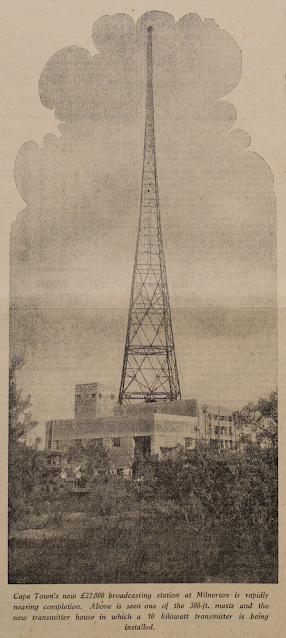
Cape Town's Broadcasting Station at Milnerton is rapidly nearing completion.
Here is seen one of the 300-ft. masts and the new transmitter house in which a 10-kilowatt transmitter is being installed.


CAPE ARGUS - 1939, January 12


Broadcast House sound of ox-cart

No, it is not a home-made toy. It is the mechanical device used at Broadcast House to suggest the creaking progress of an ox-cart. A handle is tuned and through an amplifier the effect is most realistic. 

Monday, 6 July 2020

MAXIM High Grade Clothing


THE STAR Johannesburg - 1920, July 6 & 20
THE STAR Johannesburg - 1920, July 6
Sir Robert Horne, the President of the Board of Trade, says that next winter worsted suits of the best quality will cost 20 guineas, but, much to the relief of the average man, he adds that clothes of good and sound quality will be obtainable at lower prices. 
In New York, a suit of best quality British-made cloth costs £60, in Paris £52 10s., Berlin £200 and Montreal £35.
We bought heavily twelve months ago, when many others were afraid. Consequently, today we are able to offer exceptional values in tailoring.
Lounge suits from 11 Guineas available in 3 Johannesburg Shops.
THE STAR Johannesburg - 1920, July 20


Can you afford to disregard your appearance? Think it over carefully. A well-dressed man commands immediate attention, and this attention often provides the first step toward success.
You are cordially invited to inspect the latest designs in Glen Urquhart Checks at 3 MAXIM shops in Johannesburg. The Sauer’s Buildings Branch will remain open on Wednesday Afternoons.

Tuesday, 10 March 2020

Motor Cycle Club (M.C.C.) Trials 1918 - 1939

THE STAR Johannesburg - 1918, March 14


RAND M.C.C. TRIALS
At the Rand MCC Trials held on Sunday, March 10, 1918, the following were the results:
* B.S.A.: First
* Triumph: Second
Shimwell Bros. – Sole agents for Triumph, B.S.A. & Royal Enfield Motor Cycles
British but nothing but British


Competitors at the start of the Cape Peninsula MCC Bartle Cup Competition on Easter Monday.
CAPE TIMES - 1924, April 24


CAPE TIMES - 1924, May 13
Motor Cycle Race on the Sands at Milnerton
One of the competitors about to start.


CAPE TIMES - 1924, May 13 


Motor Cycle Race on the Sands at Milnerton
A general view of the crowd and three of the competitors.


CAPE ARGUS - 1927, August 5


Strand Motor Cycle Races
After a fortnight of really hard work, the officials of the C.P.M.C.C., who were responsible for the very successful races on the Strand Beach on August 1, are enjoying a short period of relaxation prior to renewed efforts in their progressive scheme of attractive entertainments. About five thousand people attended the races and thoroughly enjoyed the entire program, with the exception of the sidecar event, the last of the day. The course was one mile long, and the bottom corner was framed by many people.
Much credit is due to the officials of the C.P.M.C.C. for the excellent management of the meeting. At the start of the first even, every one of the programs was sold – double the quantity could easily have been disposed of.
THE ACCIDENT
It has been reported that one of the competitors was seriously injure during the race. This, however, is not the case, as the unfortunate incident occurred long before the course was declared open, and even before the distance was marked off by the official measures. The accident was due to the rider speeding along the beach by himself and suddenly striking a patch of loose sand. He lost control and was conveyed to the nursing home at Somerset West. There were no other accidents during the actual races. It is refreshing to learn from the controlling club that during the long term of its activities, extending from 1910, there has never been a single instance where a competitor has been injured.
FIRST RACE
The 600 c.c. scratch race started with a surprising burst of speed by RF Bacon on his little 2¾ h.p. A.J.S., followed by Backlin (Douglas) who also had his mount tuned to a nicety. These two, with Southall (A.J.S.), were so excited that they overrun the first corner, allowing one or two of the slower machines to get round first. The little A.J.S. and the Douglas were soon in the lead again. Bacon (A.J.S.) eventually won, and registered a fast lap of 62 m.p.h. during the course of his ride.
SURPRISE OF THE DAY
The surprise of the day was seen in the novices’ race, when a little 2½ h.p. B.S.A in the hands of Bent lapped the course at 44 m.p.h. Such high speed from a miniature motor-cycle could not have been reasonably anticipated by the handicappers. This rider won the race with the two Dunelt men filling second and third positions. One of the latter did a lap at an average of 47 m.p.h., representing a really good performance for a two-strike of 2¼ h.p.
SIDE-VALVE MOUNTS
The third race was for five-valve machines, and brough out the big Harleys, it being evident at once that Short had the fastest engine on the field. His high-powered Harley simply ripped over the sand at a hair-raising speed and actually registered a lap at 72 m.p.h. This machine at one time or another must have touched nearer to 90 than 80, and when prepared and properly geared for a straight distance should attain the coveted 100 m.p.h. mark, which its rider anticipates reaching in the near future.
I do not know why it is that Short (Harley) does not figure in the awards for this race, and imagine that trouble of some kind must have prevented him from catching the speedy BSA (Symons) up which eventually won with not very much to spare from Bacon (A.J.S.) and Backlin (Douglas).
I believe that even with 72 m.p.h. being registered for his Harley, it is not the fastest speed at which the machine can lap the mile course, and think its intrepid little rider is still very wisely keeping something up his sleeve.
TEN-MILE RACE
There were one or two absentees from the ten mile s.v. race due to trouble overtaking riders in previous events. Nevertheless, the excitement was maintained when the back-markers got away. These comprised Short (Harley) and Du Toit (Harley), and although the limit man on a 2¼ B.S.A. rode well and took every advantage of his 400 seconds start, Short gained the lead near the end, only to lose it again through a slight engine seizure, which he considered could not be overlooked, and retired. This result was yet another proof of sound handicapping as the first three to finish were spread over the whole entry, the winner being GC Anderson (Dunelt) who received 320 secs. start, while HA Bent gained second place from the 400 secs. mark, and Du Toit (Harley), scratch man, coming into third position.
BACON’S TRIUMPH
What promised to be the tit-bit of the day was the scratch event for 350 c.c. o.h.v. machines, especially as rumours were freely circulated in town to the effect that the 350 c.c. experts had been tuning hard for some time past, and extremely high speeds with a hard battle for first place seemed assured. The race upheld its reputation for a few laps, when gradually yet surely riders fell out through some hidden fault. R Bacon (A.J.S.) took the lead from the start and maintained it throughout. He was never seriously challenged, and eventually won by about a quarter of a mile from HC Nolte, who was astride another A.J.S., D Van Reit (A.J.S.), a comparatively young rider, made no mistake about the third position, and deserves credit for his consistent riding. All three A.J.S.’s became monotonously consistent in the late stages of the race, and it was quite an education to watch them. It is difficult to single out any one who made more of an impression than the others, for once the three positions had been taken up, so they continued without varying the distance much until the finish. This might indicate that the leader, Bacon, had a good deal of speed to spare, but I do not think this was the case, and attribute his initial lead to quick gear changing and violent acceleration at the beginning. He certainly mad a splendid impression with his game little mount.
SIDECAR EVENT
The public were not so well impressed with the sidecar event, which was considered rather tame after the more dashing solo races. The speeds recorded were comparatively slow, and could be vastly improved upon. The most outstanding performers were Hemmens (Harley), MecFarlane (Harley), and Scott (Harley), who finished in that order. The little Morgan driven by M Longmore was among the fastest set and after completing two laps at an average of 51.5 m.p.h., was forced to retire with an oiled plug. The winner’s average for the six miles was 48.7, so that the Morgan, with its handicap of 40 secs., could have won easily if it had maintained its two-lap average for the whole race, a not impossible performance.
I am inclined to believe that the sidecar race should be made very much more spectacular if greater interest was evinced in it. If the committees desire to encourage the three-wheelers, they should enlarge the award a little, not forgetting to increase the fee accordingly.
 
CAPE ARGUS - 1927, August 5
Strand Motor Cycle Races
The big collection of cars at the Strand where motor-cycle races were held on Aug. 1, 1927.


CAPE TIMES - 1928, July 11


Metropolitan Motor Cycle Club’s Reliability Trial
A competitor in the Metropolitan Motor Cycle Club’s Reliability Trial to Sir Lowry’s Pass, starting from the Pier on Saturday.


CAPE ARGUS – 1939, January 26
Camps Bay Hill Climbing 
Thrills in plenty are promised at the Camps Bay Hill Climbing Contest to be staged by the Cape Peninsula Motor-Cycle and Car Club on the new Geneva Drive (off the Marine Drive) on Saturday. This picture was taken during a practice run today.

Saturday, 7 March 2020

Best Bicycles: 1906 - 1939

CAPE ARGUS - 1906, July 27

Raleigh Cycles
Admitted by all to be the World’s Best Bicycle, fitted with Free Wheel, 2 Rim Brakes, Tool Bag, Tools, Inflator and Clips complete.


CAPE ARGUS - 1906, July 
Rudge-Whitworth Cycle
Ask for the finest and most beautifully illustrated book ever published about Bicycles – post free.
50 models: £7to £15 15s.


CAPE ARGUS -1906, December 5
New Hudson Cycles
The Leading British Make fitted with every Up-To-Date Improvement for making cycling easy and pleasurable; and including a number of detail improvements especially valuable for South African use.


CAPE ARGUS - 1906, December 5


Raleigh Cycles are and always have been the World’s Best. Prices to suit all pockets. See our Rheebuck at 
£7. Easy payments arranged. 


CAPE ARGUS - 1906, December 20
Rudge-Whitworth Cycle
Expert Cyclists take their stand on the Rudge-Whitworth Catalogue – the most complete guide which describes the details of Britain’s Best Bicycle.


THE STAR Johannesburg - 1918, January 29


Raleigh – Rigid, Rapid, Reliable
Rigidity by its extreme strength of design; Rapidity by its beautiful construction and Reliability by the excellence of material and labour employed. With Dunlop tyres and Sturmey-Archer 3-speed gear, perfect!


THE STAR Johannesburg - 1918, February 5
Raleigh – The All-Steel Bicycle
“There are no roads at all, only narrow paths through the forests, just wide enough for one man to walk, along,” writes Mr. Percy Last, a Uganda missionary, “but my Raleigh is perfectly right and as silent as the grave. I am more than ever convinced of the value of it.”
Guaranteed for Ever – the famous all-steel bicycle, with Dunlop tyres and Sturmey-Archer 3-speed gear, is as good in jungle as on track.


THE STAR Johannesburg - 1918, February 28
Ride a B.S.A. Cycle
There are numerous occasions in every home and business place when it would be a convenience and a saving of valuable time to have a bicycle handy. Shopping, delivering urgent messages, business calls, are a few of the things which can be easily and rapidly accomplished by cycling.
Ride a B.S.A. - Perfect in every part, and ensure years of reliable service. The few shillings difference between a genuine B.S.A. and a so-called cheap machine is more than counter-balanced by the freedom from trouble and expense which B.S.A. quality gives.
Every Part of a B.S.A. Bicycle is Guaranteed Interchangeable.


CAPE ARGUS - 1918, November 18
Have you tried a Cycling Holiday?
In congenial company you can take the most interesting and delightful routes – breaking your journey just when and where you desire. Cycling will double the enjoyment and benefit of your holiday besides being much more economical than the railway.
Ride a B.S.A. Bicycle – Perfect in Every Part – and ensure cycling under perfect conditions. B.S.A. quality material and workmanship is known the world over. Every genuine B.S.A. Bicycle bears the trade mark of the three piled rifles.


THE STAR Johannesburg - 1920, July 22


B.S.A. Cycle – “Perfect in every part.”
Why not cycle those unpleasant journeys and reach your destination quicker and in comfort on a B.S.A. Bicycle? The economy, pleasure and health derived from a B.S.A. Bicycle will soon repay the initial cost. All B.S.A. parts are guaranteed interchangeable.


CAPE ARGUS - 1939, January 19
Raleigh – Easy Running
Raleigh cycling will be a new experience for the enthusiast – every part of this reliable cycle has been designed for easy-running and effortless riding. The Raleigh cycle has a fine quality steel frame, heavily enameled, ensuring a beautiful rust-proof finish. The saddle is super-strong. It pays to buy a Raleigh – the cycle with miles more wear.

Point 5 of Raleigh Perfection: HUBS
The Raleigh is Easy-riding. Ball bearings of specially hardened steel are fitted to Hubs, gear wheel and pedals. Automatic Free Wheel.


CAPE ARGUS - 1939, March 20
Strength and Endurance
Get the best out of cycling with a Raleigh – built by craftsmen for long life and dependability. All Raleigh cycles have chromium-plated spokes – the frame and mudguards are beautifully enameled with a special long wearing finish. These features keep your cycle smart. Get on to trouble-free cycling right away – get on to a Raleigh!

Point 2 of Raleigh Perfection: FORKS
Raleigh forks are tremendously strong and rigid. The crown is pressed from a single piece of steel – ensuring immense strength with exceptional lightness. Exclusive to Raleigh cycles.


CAPE ARGUS - 1939, March 20
Speed with Safety
Mile after mile of safe, effortless riding is yours when you buy a Raleigh. This famous cycle is fitted with extra dependable brakes, a super sprung saddle and many other refinements including chromium-plated steel spokes. Raleigh cycles incorporate the best design and the best workmanship – yet the cost is within reach of every cyclist’s pocket.

Point 1 of Raleigh Perfection: BRAKES
Every Raleigh cycle has rim-type action Brakes fitted with extra durable brake blocks, giving ease of control and long wear.


Cape Town’s new £22 000 Broadcasting Station at Milnerton

 CAPE TIMES - 1933, July 18 The Cape and Peninsula Broadcasting Association started Cape Town’s first Broadcasting Station on September 15, ...