Showing posts with label Stellenbosch. Show all posts

Sunday, 26 April 2020

Place-names in South Africa

CAPE TIMES – 1924, May 30
C. Graham Botha mentioned that the study of South African place-names should commend itself to all. It serves a twofold purpose: it is an aid to the study of the geography of the country and stimulates an interest in its early history. Before the arrival of the Europeans in 1652 many of the bays and capes along the coast had received names. There were mostly of Portuguese origin. Others had been named later by some of the early Dutch navigators.
Inland the case was different. No white man had penetrated more than a few miles in order to barter cattle with the natives. Such names as appear on maps before this relate only to large areas occupied by the natives.
If we take places within a radius of say a hundred miles of Cape Town, we will find many that will disclose early history in their origin. Those names that have a Portuguese origin are found in several of the names of bays and capes. SALDANHA BAY was the first name given in 1503 to TABLE BAY, and commemorated a Portuguese navigator, Antonio da Saldanha. In 1601 the Dutch, however, gave its present name, which is derived from TABLE MOUNTAIN. The name SALDANHA was transferred to an inlet higher up the western coast. In 1497 Vasco da Gama anchored in ST. HELENA BAY, which he names because it was first seen on that Saint’s Day. CAPE AGULHAS (Needles) does not refer to the pointed rocks in its locality, but to the fact that the needle pointed due north. It was at first called Ponto de S. Brandao, that being the Saint in whose honour it was named. It is probable Dias dedicated the southern-most cape of all Africa to this Saint, an apocryphal Irishman, whose day is the 16th May. On an early map of 1489 the present FALSE BAY is marked as Golfo dentro das serras (gulf within the mountain ranges). This would seem to be an appropriate name. The present name, given by the Portuguese at an early date, would appear to have derived its origin from the Cape which bore that name or vice verso.
NATIVE NAMES
When we come to the native period, and look at some of the inland names that have survived, we find these refer mostly to the physical feature of the country. SOUQUA’S DRIFT in the Malmesbury district comes from the native tribe, the Souquas, meaning murderers and robbers. The termination qua means the people of --- sons or men of. There were several qua tribes in the early days, but many of their names have not been perpetuated – e.g., the Inqua and the Chanouqua. Each native tribe usually took its distinctive tribal name from that of the chief under whom it had become independent. For instance, the Cochoqua were ruled by the Chief Cocho, and the Gonaqua by Gona. In the VAN RHYNSDORP district we find KONAQUAS BERG, probably referring to the latter. There are several Hottentot names with the termination DOUW, and sometimes TOUW. This refers to the Hottentot “daob” (feminine, “daos”) a poort, a mountain pass or path. The name with which it is compounded will invariably be found to refer to a path over or between a range of mountains. In the north-west we find such names as WIDOUW, BIDOUW, KRAKADOUW, NARDOUW, CARDOUW. Then, in the south-east, there is TRADOUW PASS, which comes from “taras” (a woman) and “daob” (a path). It may be of interest to note that SIR LOWRY’S PASS was called GANTOUW by the Hottentots, which comes from “kani” (an Eland) and “daos” – i.e., the Eland’s Paths. This would be very appropriate, for it showed that the natives followed the tracks of the eland to get over the other side of the mountain.

HIGH-PLACED OFFICIALS
The nomenclature of South Africa includes a number of names commemorating governors and government officials. The first Commander of the Cape, Jan van Riebeeck, is remembered in RIEBEECK KASTEEL, named in 1661. STELLENBOSCH was named in 1679 by Governor Simon van der Stel, to perpetuate his own name and commemorate the “bosch” or forest which he admired in the vicinity of the present town. SIMON’S BAY and SIMON’S TOWN were named after him also. SWELLENDAM, the third oldest town in the Province, was named in 1747 after Governor Hendrik Swellengrebel and his wife, whose maiden name was Ten Damme. The name of a Governor-General of Batavia, who was passing through on his way to the East, is recalled by a well-known farm in the Peninsula, INHOFF’S GIFT, recalling Baron van Imhoff’s visit in 1743. One Governor has made certain that members of his family should be lost to posterity. This was Lord Charles Somerset. There are about half-a-dozen names which he gave.  Of these there are SOMERSET WEST, PORT BEAUFORT, and WORCESTER, in addition to several towns which have streets called after him. The names of fathers-in-law of some of the Governors have also been given to places, such as CLANWILLIAM, called after the first Earl of Clanwilliam, whose daughter married Sir John Cradock. MALMESBURY was named after the first Earl of Malmesbury, the father-in-law of Sir Lowry Cole. The latter also gave his name to SIR LOWRY’S PASS, which was opened in 1830. MAITLAND, NAPIER, DURBANVILLE and DARLING all commemorate former Governors.
The names of many Government officials and statemen are included in our list of place-names. If we take our road-engineers, or those responsible for the administration there-of, we have MICHELL’S PASS, BAIN’S KLOOF, ROBINSON’S PASS, GARCIA and SOUTHEY PASSES. MONTAGU bridge, near SALT RIVER, recalls the name of John Montagu, the Secretary to Government. RIVERSDALE, named in 1838, records the name of Harry Rivers, a former Magistrate of Swellendam; PORTERVILLE, a former Attorney-General (Wm. Porter); and RAWSONVILLE, a secretary to Government. BREDASDORP, named about 1838, is one of the first towns to perpetuate the name of a South African. It was called after the Hon. Michiel van Breda, a member of the Legislative Council.
MILITARY SIGNAL STATIONS
In many districts of the Western Province will be found mountain peaks or eminences with the name of KANONKOP or KANONBERG (Cannon Hill). These are reminders of the days when the burgher militia were called to arms by means of signal guns placed on some prominent position along the mountain ranges. The first signal was given from The Castle, and the signalmen at the various stations inland took up the report and fired their cannon. On several of these points will still be found the old guns used in the 18th century. When the alarm was sounded every farmer had to saddle up and come fully armed and with a few days’ rations. In connection with the burgher militia of those days we still have the name of PAPEGAAISBERG (Parrot Hill) at Stellenbosch. This owes its name to the fact that the militia practiced target shooting here at their annual training. The target took the form of a parrot, and points were awarded according to which part of the bird the marksman hit.
These few examples of place-names will give the motorist some food for thought. He will often find it a fascinating pastime, as he travels through various districts, to inquire the origin and history of some of the place-names.

Friday, 6 December 2019

Ida’s Valley Homesteads


CAPE ARGUS – 1939, January 3
Stellenbosch was the favourite child of Simon van der Stel. He loved it for its beauty, its fertility, and the pleasing contours of its hills and valleys. He gave its name to the embryo village, and he granted land to several of his friends in the Ida’s Valley, most lovely of all the valleys, under the shadow of his own Simonsberg.
Several of the old homesteads still survive. Time has dealt with them kindly. One of these is RUSTENBERG, on the land granted to the Landdrost Peter Robbertz, who came to the Cape in 1696. The house is H-shaped, with white-washed walls, large, low windows, simple gables and a thatched roof. The curved steps leading up to the flagged stoep are made of tiny Batavian bricks, brought over by the Dutch East India Company at the command of the first owner. A grant of land nearby was made to the Huguenot exile, Francois Villon, of Clermont, in 1692; and he probably lived in an earlier house, traces of which may still be seen, near the present homestead of Ida’s Valley. The neighbouring farm of Schoongezicht, for long the property of John X Merriman, also has a charming house, built rather high up, with a view of the Stellenbosch valley.
RUNNING WATER
Every homestead in the valley has white-washed walls and a thatched roof, and is surrounded by oak trees and running water.
There sluits of water round the house are a tradition surviving from the old days when, in the summer-time, the slaves used to lay the dust around the house by scooping water out of the sluits with a tin dipper, and sprinkling it liberally over the road.
This is not the only thread left from the tapestry of past years. Everywhere are to be found signs of earlier settlers, and of their customs and way of life. At Schoongezicht wine is still made in the gabled wine cellar, and the grapes are still pressed out by human feet. At Rustenberg, the slave hole under the house is now used for the more prosaic purpose of storing logs of wood, but it is still very dark and mysterious. In the loft under the thatch apples and pears are spread out on straw to keep for the winter months. Thrifty Dutch housewives of a century or more ago kept their stores in much the same way, in the days before cold storage was though of, and they hung their bunches of herbs and their home-cured hams on the same broad rafters.
The old homesteads in the valley were built for coolness, with high ceilings, thatched roofs and large windows. All the rooms are large and rather draughty. Fireplaces are scarce, and it would need a roaring fire to warm those huge, airy rooms. It is supposed that earlier tenants just retired to bed with a large, copper warming-pan when winter frosts set in. Present owners installed fireplaces and plenty of electric heaters.
MODERN HOMES
Besides the old Dutch homesteads of Ida’s Valley, Schoongezicht and Rustenberg, there are some charming new houses in the valley, which have been built on bits of land cut off from the three original farms. One of these is Kelsey Farm, built on a hilltop above Rustenberg – a low-eaved thatched house with a peerless view and surrounded by vineyards. Another is the House in the Woods, built among the poplar trees on a piece of Ida’s Valley. Numerous other cottages have sprung up as more and more people have realized what a delightful part of the world this is in which to live. All are comely, with their thatched roofs and white-washed walls, and are in keeping with the spirit of the valley.
The grey curves of Simonsberg rise above the valley, which is watered by springs from its ravines. Among the rocks near the summit live a troop of baboons, which raids the upper farms for fruit and mealies when roots get scarce on the mountainside. On the very top is an old Hottentot cave, supposed to have been the refuge of runaway slaves. But one cannot help feeling that only a very foolish or very frightened slave would leave the comfortable life of the valley for the inhospitable mountain heights.
THE FAMOUS OAKS
If you read through the dispatches of Simon van der Stel, you will come across this letter the Landdrost, Ditmars, of Stellenbosch, dated July 13, 1701. “We send you, for the benefit of the Stellenbosch community, a wagon laden with young oak trees, which with the co-operation of the Reverend Hercules van Loon, are to be planted – wherever possible. They are at once to be put into the ground, lest they perish through delay.”
This accounts, in part, for the beautiful old trees to be found everywhere in the valley. It was part of the governor van der Stel’s policy to plant plenty of oak trees, and he guessed how well they would flourish in this fertile soil. At Rustenberg is a giant oak tree filled with stones and cement to hold it up, as its core has long since rotted. Yet it still produces its crown of green leaves every summer, and gives every indication of robust life. It must be more than a hundred years old, and many generations must have sheltered beneath its gnarled branches.
TREES OF MANY KINDS
Besides oak trees, there are poplar woods, delicate and silvery; tall rows of Lombardy poplars to shelter the orchards, which in autumn are a golden delight; avenues of plane trees and flowering gums; a silver tree plantation; Spanish chestnuts in sheltered gullies; wild olives and fir forests on the mountain slopes. At Schoongezicht a giant mulberry tree bears its yearly crop of crimson berries. At Rustenberg weeping willows droop delicately over the swimming pool, until they nearly touch the blue water-lilies below; and on their branches, weaver birds build their nests.
So far, I have not even mentioned the fruit trees – in Ida’s Valley one takes them for granted. Since the business of the valley is fruit, every bud is watched with care, every south-easter dreaded once the fruit has formed, and all market prices studied with apprehension. The busiest time of the ear is the fruit season, starting in December and ending in March or April, when the last pears and apples have been placed in their wood-wool nests in the fruit boxes and consigned to foreign ports or home markets, according to their size, quality and degree of ripeness. The summer months mean constant toil to the fruit farmer as his merchandise is perishable. It must be picked and packed at an exact stage of ripeness, and like time and tide, it waits for no man.
Yet it would be impossible to get any real sense of hustle in this valley of green trees and cooling streams. One feels that land may be bought and sold, men may come and go, and farmers may sweat to wrest a living from the soil; but the tranquility of the year will remain in Ida’s Valley – a snare for settlers, a benediction to the world-weary, and a constant tribute to the good taste of Governor van der Stel. – The Hon. Yvonne de Villiers

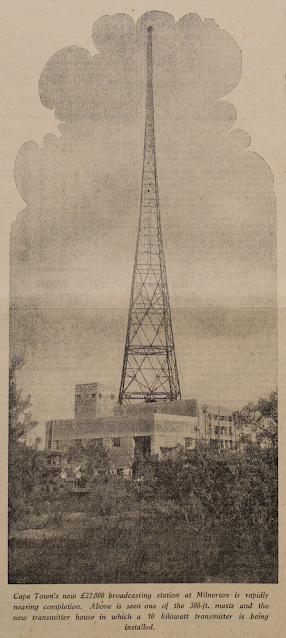
Cape Town’s new £22 000 Broadcasting Station at Milnerton

 CAPE TIMES - 1933, July 18 The Cape and Peninsula Broadcasting Association started Cape Town’s first Broadcasting Station on September 15, ...