Showing posts with label Greece. Show all posts

Saturday, 9 November 2019

Wine Exports to Sweden


CAPE TIMES – 1933, August 8
Sweden’s increased imports of South African Wines, referred to by the Union Trade Commissioner in Sweden, are attributed by the K.W.V. officials to the fact that South Africa has concentrated on supplying genuine wines of the Cap Constantia type.
Germany had for many years exported large quantities of wine, known as Cap Constantia, to Sweden one of the officials told the Paarl representative of the Cape Times yesterday. This variety, however, was a concoction of cheap Continental wines mixed with a small blend of South African Cap Constantia.
As the result of a report received by the K.W.V. from the Union Trade Commissioner in Great Britain, the K.W.V. had concentrated on supplying the genuine article direct to Sweden. This South African wine had no difficulty in ousting the Continental brands, and the Union’s exports increased last year by 365 percent, while the German wine manufacturers and exporters had lost 45 percent of their wine trade with Sweden.
STILL EXPANDING
Whereas German exported 86 229 litres to Sweden in 1931, this figure dropped to 47 587 litres that year. On the other hand, South African exports to that country increased of 1 litre, or .22 gallons a day.
Although this was only the K.W.V.’s second year of export to Sweden, the market had assumed large dimensions and was still expanding. South Africa now ranks third on the list of wine exporters to Sweden. Portugal still leads with an export of 1 588 864 litres while Spain is the runner-up with 413 229 litres.
The Portuguese exports to Sweden have, however, diminished by 36 percent, while the Spanish trade has suffered a decrease export of 30 percent. The only other country, besides South Africa, that showed an increased export of wines to Sweden was Italy, who last year consigned and sold 40 percent more wine on the Swedish market than during 1931.
The wine exports from Greece to Sweden in 1932 decreased by 63 percent. The French market in in Sweden showed the lowest decrease, of only 2 percent.

Read more about the Press Release: Wines of South Africa Export Report 2018 
at   https://www.wosa.co.za/Wosa-News/Press-Releases/2019/Press-Release--Export-Report/

Tuesday, 20 August 2019

Origin of Tyres

CAPE TIMES – 1933, August 18
Where did the name "TYRE" come from?
The origin of the name “tyre” is shrouded in antiquity. There are at least two theories as to its derivation. One traces it to the Phoenician city of Tyre.
When Alexander the Great entered this city in 332 B.C. his war chariots were equipped with wooden wheels bound with iron or bronze. But here Alexander found other chariots magnificently constructed and reserved for the pleasure of the rich. He was impressed with the wheels on the pleasure chariots which had, secured by thongs to the bronze rims, an outer rim of leather.
This is the first known use of a tyre for reducing vibration and thereby promoting the comfort of the passenger, although, when Tutankhamen’s tomb was opened up by Lord Carnarvon and Mr. Howard Carter, the remains of a chariot were found, with wheels which, to all appearances, had carried some form of tyres.
Leather tyres were soon introduced into both Greece and Italy and even though iron and bronze wheel-rims had been in use for centuries before Alexander’s day it is just possible that the word “tyre” originated from the Greek or Latin name of this Phoenician city where this early cushion tyre is said to have been used.
Another theory favours a British origin. In ancient Britain it is said, the iron rims that bound the wooden cart wheels were called “tie-ers.”
In 1845 R. W. Thompson, a Scots road locomotive engineer, invented the first air-inflated tyre, which was laced or bolted to the carriage wheel. It consisted of plies of canvas saturated with rubber, but failed as the rubber was not vulcanized.
Forty years passed before anyone again gave serious thought to the possibilities of pneumatic tyres. But during this interval solid rubber tyres were generally used on bicycles and carriages and in 1884 Macintosh introduced the cushion tyre. This tyre, with a succession of cavities in the form of a spongy mass in the centre, was more resilient and was adopted at once for carriages.


THE STAR Johannesburg - 1918, February 28
Then in 1888, as recently described in The Austin Magazine, John Boyd Dunlop invented the first practical pneumatic tyre. So many inventors set to work to improve on J.B. Dunlop’s idea that for the next few years the Patent Offices in both England and the United States were deluged with applications.
Sometime antecedent to 1895 Dunlop motor tyres first appeared and in that year Dunlop 30 in. x 6¼ in. motor tyres were in use. With the Dunlop tyres of 1902 a foot pump and repair outfit were supplied! Incidentally, the minimum tyre pressure advised was 75 lb. per square inch!
In France the pneumatic tyre was first adopted for the motor-car in the early nineties, by the Michelin brothers, who unable to adapt the new type of tyre to their cars, actually built a car to fit the tyres. Though their first experiments were discouraging, by 1896 their pneumatic motor-car tyre was on the market. 

De Volkstem - 1925, 8 October

From that time the improvement of motor-car tyres kept steady pace with car improvements. The first effort to overcome skidding, which frequently occurred with the smooth rubber threads, was the invention of a leather thread studded with steel rivets and vulcanized to the rubber tyre. Then came the moulded rubber non-skid thread more or less as we know it today. The first cord tyre was invented in 1893 by John F. Parmer, of Chicago, and was at that time a bicycle tyre. Some time later a cord tyre for electric automobiles was introduced known as the “Power Saver.” Later came the cord tyre for motor-cars, which has now replaced entirely the square woven fabric tyre of all types. The cord construction, which employs cords laid to the inflated shape of the tyre cover, so that no internal stresses are set up when the tyre is fully inflated, is used throughout the world today, and is actually the same as that used in the “Power Saver” tyres of 25 years ago. 
(G.J. Joint in Austin Magazine)

CAPE ARGUS - 1918, November 8

THE STAR Johannesburg - 1918, March 7


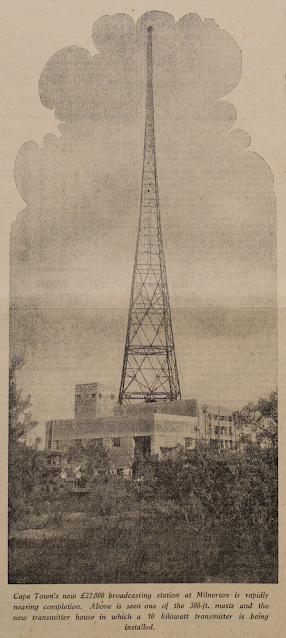
Cape Town’s new £22 000 Broadcasting Station at Milnerton

 CAPE TIMES - 1933, July 18 The Cape and Peninsula Broadcasting Association started Cape Town’s first Broadcasting Station on September 15, ...