Showing posts with label Scotland. Show all posts

Friday, 3 February 2023

Snap, Crackle & Pop

THE STAR Johannesburg - 1918
CAPE TIMES - 1928 & 1933


Do you remember the slogan 
“Snap, Crackle and Pop?” 
Have a look at how old the famous Kellogg’s Rice Krispies and other cereals are!


Kellogg’s Rice Krispies
When you want to give the children a light, but satisfying meal there’s nothing better than Kellogg’s Rice Krispies. Made from kernels of wholesome rice, they are toasted to a delicious golden brown – so light they snap, crackle and pop in cold milk or cream. Children and grown-ups alike enjoy their tasty flavor and crunchy goodness. Try them today. No cooking required. Sold by all grocers in the red-and-green packet. 
(CAPE TIMES - 1933, August 5)


Old John Oats
Cooked in five minutes. The genuine Scotch porridge, prepared with a minimum of trouble. Made by John Grant & Sons, Ltd., Craig Mills, Dundee, Scotland 
(THE STAR Johannesburg - 1918, Jan.19)


Kellogg's Rice Krispies 

New – Different – Delicious

All the children are excited about this new cereal – Kellogg’s Rice Krispies. So different from anything you have ever known.

Lively little bubbles of toasted wholesome rice, that SNAP, CRACKLE AND POP as they float lightly on milk or cream. Get a packet today, mother, and give the children a real treat. No trouble at all. No cooking.

Serve direct from the packet with cold milk or cream. Sweeten with sugar if desired. At your grocer’s in the red-and-green packet – always oven-fresh – protected by the patented inner WAX-TITE bag. (CAPE TIMES - 1928, August 1)


Post Toasties
You have not tasted Corn Flakes at their best until you have eaten POST TOASTIES – a breakfast cereal with winning flavor. By a special process of cooking, rolling and toasting, the true, rich flavor of ripe Indian corn is brought out. This splendid food comes in sealed packets, air-tight and crisp. Eat with cream or milk. Delicious! Made by Meyer, Bridgens & Co., Ltd. 
(THE STAR Johannesburg - 1918, Feb. 14)

Pioneer “Crunchies” 
– South African Corn Flakes
Fresh, appetizing, wholesome, these South African Cornflakes will tempt the appetite of children who do not care for ordinary cereals. Although ready to serve, they may be prepared in a variety of ways and at any meal. 
(THE STAR Johannesburg - 1933, Aug. 31)

Read about the goodness of RICE KRISPIES as a Pre-Workout Snack @ https://www.medicalnewstoday.com/articles/why-do-people-eat-rice-krispies-before-working-out

Wednesday, 15 January 2020

Nursery Schools in Changing Social Conditions


CAPE ARGUS - 1939, January 16
The Cape Peninsula has had an enviable reputation for the quality of its schools since the days when the late Sir Thomas Muir was director of the Cape Education Department and brought highly trained teachers to the country to organize the schools and training colleges. Most of these teachers he imported from Scotland, where the standard of education was high, and the thoroughness of their methods soon made its mark on Cape education.
As the city has extended and its population increased the number of schools has multiplied accordingly. The decision to make the age of school attendance six and to start the Government schools at Standard 1 has led to the opening of a great number of private nursery and kindergarten schools. These have been opened in neighbourhoods where there are many households with young children. The children have not far to travel to school and their attendance is not the strain on the time of the parents that it would be at a central school.
The increase of quick traffic on the roads has made it impossible for young children to go unattended if the school is any distance from the home or if there are main thoroughfares to be crossed. These kindergarten schools frequently take the child to the third or fourth standard, and by that time the child’s traffic sense should be sufficiently trained to enable him to go back and forth to the high school in safety.
NURSERY TRAINING
The nursery school for children from two years old to the kindergarten stage is something new and has been necessitated by our changing social conditions. Families are smaller than in the few generations previous and the mother’s interests are no longer bounded by her home and children. Many families live in flats or in small houses with gardens hardly adequate for play. Well-trained nursemaids are hard to come by and they are an expense that many families cannot afford.
To help parents out of all these difficulties the nursery school has come into fashion, and that it is likely to flourish must be the belief of the Society for the Protection of Child Life, which is opening a training school for nursery school teachers at the end of February.
The training school will be combined with a nursery school and both will be housed in a new building in the grounds of the Lady Buxton Home, Paradise Estate, Claremont.
Applications are invited from young women who wish to take the teacher’s course in pre-school education. The full course covers a period of three years, but this period may be shortened according to the educational qualifications of the applicant. The training course and syllabus has the approval and blessing of the Union Education Department. The fees for the student teachers are £21 a term and include the midday meal. Twelve students can be trained at the same time. The nursery school has accommodation for 40 children, who must be between the ages of two and six years. The school provides medical inspection and advice, well-balanced meals, sufficient daily rest, play facilities and companions of a like age.

Read more about LADY BUXTON HOME - one of the most established Educare and Pre-Primary Centres in the Peninsula, providing a safe, secure and structured environment in which the child is nurtured and allowed to develop holistically in order to reach its full potential - https://www.rainbowkids.co.za/lady-buxton-centre.html

Monday, 16 September 2019

Snap, Crackle & Pop!

THE STAR Johannesburg - 1918
CAPE TIMES - 1933
Do you remember the slogan “Snap, Crackle and Pop?” Have a look at how old the famous Kellogg’s Rice Crispies and other cereals are!


Kellogg’s Rice Crispies
When you want to give the children a light, but satisfying meal there’s nothing better than Kellogg’s Rice Crispies. Made from kernels of wholesome rice, they are toasted to a delicious golden brown – so light they snap, crackle and pop in cold milk or cream. Children and grown-ups alike enjoy their tasty flavor and crunchy goodness. Try them today. No cooking required. Sold by all grocers in the red-and-green packet. 
(CAPE TIMES - 1933, August 5)

Old John Oats
Cooked in five minutes. The genuine Scotch porridge, prepared with a minimum of trouble. Made by John Grant & Sons, Ltd., Craig Mills, Dundee, Scotland 
(THE STAR Johannesburg - 1918, Jan.19)


Post Toasties
You have not tasted Corn Flakes at their best until you have eaten POST TOASTIES – a breakfast cereal with winning flavor. By a special process of cooking, rolling and toasting, the true, rich flavor of ripe Indian corn is brought out. This splendid food comes in sealed packets, air-tight and crisp. Eat with cream or milk. Delicious! Made by Meyer, Bridgens & Co., Ltd. 
(THE STAR Johannesburg - 1918, Feb. 14)

Pioneer “Crunchies” – South African Corn Flakes
Fresh, appetizing, wholesome, these South African Cornflakes will tempt the appetite of children who do not care for ordinary cereals. Although ready to serve, they may be prepared in a variety of ways and at any meal. (THE STAR Johannesburg - 1933, August 31)

Tuesday, 20 August 2019

Origin of Tyres

CAPE TIMES – 1933, August 18
Where did the name "TYRE" come from?
The origin of the name “tyre” is shrouded in antiquity. There are at least two theories as to its derivation. One traces it to the Phoenician city of Tyre.
When Alexander the Great entered this city in 332 B.C. his war chariots were equipped with wooden wheels bound with iron or bronze. But here Alexander found other chariots magnificently constructed and reserved for the pleasure of the rich. He was impressed with the wheels on the pleasure chariots which had, secured by thongs to the bronze rims, an outer rim of leather.
This is the first known use of a tyre for reducing vibration and thereby promoting the comfort of the passenger, although, when Tutankhamen’s tomb was opened up by Lord Carnarvon and Mr. Howard Carter, the remains of a chariot were found, with wheels which, to all appearances, had carried some form of tyres.
Leather tyres were soon introduced into both Greece and Italy and even though iron and bronze wheel-rims had been in use for centuries before Alexander’s day it is just possible that the word “tyre” originated from the Greek or Latin name of this Phoenician city where this early cushion tyre is said to have been used.
Another theory favours a British origin. In ancient Britain it is said, the iron rims that bound the wooden cart wheels were called “tie-ers.”
In 1845 R. W. Thompson, a Scots road locomotive engineer, invented the first air-inflated tyre, which was laced or bolted to the carriage wheel. It consisted of plies of canvas saturated with rubber, but failed as the rubber was not vulcanized.
Forty years passed before anyone again gave serious thought to the possibilities of pneumatic tyres. But during this interval solid rubber tyres were generally used on bicycles and carriages and in 1884 Macintosh introduced the cushion tyre. This tyre, with a succession of cavities in the form of a spongy mass in the centre, was more resilient and was adopted at once for carriages.


THE STAR Johannesburg - 1918, February 28
Then in 1888, as recently described in The Austin Magazine, John Boyd Dunlop invented the first practical pneumatic tyre. So many inventors set to work to improve on J.B. Dunlop’s idea that for the next few years the Patent Offices in both England and the United States were deluged with applications.
Sometime antecedent to 1895 Dunlop motor tyres first appeared and in that year Dunlop 30 in. x 6¼ in. motor tyres were in use. With the Dunlop tyres of 1902 a foot pump and repair outfit were supplied! Incidentally, the minimum tyre pressure advised was 75 lb. per square inch!
In France the pneumatic tyre was first adopted for the motor-car in the early nineties, by the Michelin brothers, who unable to adapt the new type of tyre to their cars, actually built a car to fit the tyres. Though their first experiments were discouraging, by 1896 their pneumatic motor-car tyre was on the market. 

De Volkstem - 1925, 8 October

From that time the improvement of motor-car tyres kept steady pace with car improvements. The first effort to overcome skidding, which frequently occurred with the smooth rubber threads, was the invention of a leather thread studded with steel rivets and vulcanized to the rubber tyre. Then came the moulded rubber non-skid thread more or less as we know it today. The first cord tyre was invented in 1893 by John F. Parmer, of Chicago, and was at that time a bicycle tyre. Some time later a cord tyre for electric automobiles was introduced known as the “Power Saver.” Later came the cord tyre for motor-cars, which has now replaced entirely the square woven fabric tyre of all types. The cord construction, which employs cords laid to the inflated shape of the tyre cover, so that no internal stresses are set up when the tyre is fully inflated, is used throughout the world today, and is actually the same as that used in the “Power Saver” tyres of 25 years ago. 
(G.J. Joint in Austin Magazine)

CAPE ARGUS - 1918, November 8

THE STAR Johannesburg - 1918, March 7


Monday, 3 June 2019

Mrs. Tommy Cullinan - Popular Motorist in Johannesburg

THE STAR Johannesburg, 1935, August 1


MRS. TOMMY CULLINAN is an extremely popular motorist in Johannesburg. She has driven different types of cars for some years and is now using a BABY FORD. She has been driving in many parts of South Africa and also enjoyed her recent motoring experience in Scotland. This trendsetter is also partner of a small gift shop in the American style in Johannesburg. She is the daughter-in-law of Sir Thomas Cullinan, the South African diamond magnate renowned for giving his name to the Cullinan Diamond.

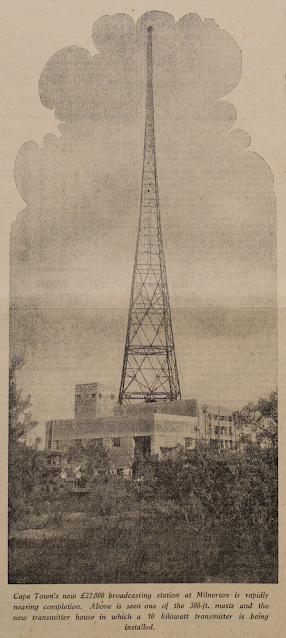
Cape Town’s new £22 000 Broadcasting Station at Milnerton

 CAPE TIMES - 1933, July 18 The Cape and Peninsula Broadcasting Association started Cape Town’s first Broadcasting Station on September 15, ...