Showing posts with label Italy. Show all posts

Thursday, 30 January 2020

How the S.O.S. Call Originated


CAPE TIMES - 1924, May 27
The origin of the distress signal of ships at sea, now familiar to most people, has always caused considerable curiosity. The first suggestion of a distress call for ships was made by the Italian delegates at an early conference on wireless telegraphy, held in Berlin in 1903. These delegates urged the adoption of a universal signal, “SSSDDD,” to be sent by ships in distress. Shore stations and other ships, upon picking up such a signal would then stand by for further messages and suspend other communication immediately.
The final decision to adopt such a signal, however, was left to a special conference, but before anything came of it the Marconi Company, recognizing the need for a distress call, instituted on February 1, 1904, by general order, the famous call, “CQD,” on all their ships. This signal was a combination of the general call “CQ” coupled with the letter “D” to signify distress.
Only by the order of the captain of a ship in distress could it be used, or by a station retransmitting the signal. All stations were to recognize the urgency of the call and make every effort to establish satisfactory communication without delay. Several countries, including the United States, adopted “CQD,” and used it until the Berlin regulations were ratified.
A GERMAN SUGGESTION

At the Radio Telegraph Conference held in Berlin in 1906, the German government submitted a suggestion “that the ships in distressed will make use of the following special danger signal: . . . ― ― ― . . . (SOS).
Previously, German ships desiring to communicate with all vessels in their proximity, without knowing the names of calls, would send an inquiry signal, “SOE.” Germany planned to suggest this signal as the international signal, but as the last letter “E” represented in Morse by a single dot, was not believed sufficiently characteristic, the delegates in 1906 suggested the final letter as “S,” thereby having the honour to define what became the universal signal.
Whilst interpretations such as “Save Our Souls” and “Save Our Ship” should be accepted with reserve, there is this about it, that if these interpretations are not true, they are cleverly invented. In a similar manner the literal translations offered for “CQD” were
Come Quickly, Do,” and “Come Quick! Danger!”
The distress signal “SOS” was adopted officially and put into effect by the International Radiotelegraphic Convention of Berlin in July, 1908.
It was naturally a matter of keen regret to the Marconi operation that their old signal “CQD” was not adopted, and many continued to send “CQD” as well as “SOS” when accidents occurred. “CQD,” however, was gradually forgotten. In 1912 the USA adopted “SOS” when the international agreement was accepted.
It is pointed out that the signal today is “SOS” without space. The Morse man will readily understand the difference. 

Tuesday, 20 August 2019

Origin of Tyres

CAPE TIMES – 1933, August 18
Where did the name "TYRE" come from?
The origin of the name “tyre” is shrouded in antiquity. There are at least two theories as to its derivation. One traces it to the Phoenician city of Tyre.
When Alexander the Great entered this city in 332 B.C. his war chariots were equipped with wooden wheels bound with iron or bronze. But here Alexander found other chariots magnificently constructed and reserved for the pleasure of the rich. He was impressed with the wheels on the pleasure chariots which had, secured by thongs to the bronze rims, an outer rim of leather.
This is the first known use of a tyre for reducing vibration and thereby promoting the comfort of the passenger, although, when Tutankhamen’s tomb was opened up by Lord Carnarvon and Mr. Howard Carter, the remains of a chariot were found, with wheels which, to all appearances, had carried some form of tyres.
Leather tyres were soon introduced into both Greece and Italy and even though iron and bronze wheel-rims had been in use for centuries before Alexander’s day it is just possible that the word “tyre” originated from the Greek or Latin name of this Phoenician city where this early cushion tyre is said to have been used.
Another theory favours a British origin. In ancient Britain it is said, the iron rims that bound the wooden cart wheels were called “tie-ers.”
In 1845 R. W. Thompson, a Scots road locomotive engineer, invented the first air-inflated tyre, which was laced or bolted to the carriage wheel. It consisted of plies of canvas saturated with rubber, but failed as the rubber was not vulcanized.
Forty years passed before anyone again gave serious thought to the possibilities of pneumatic tyres. But during this interval solid rubber tyres were generally used on bicycles and carriages and in 1884 Macintosh introduced the cushion tyre. This tyre, with a succession of cavities in the form of a spongy mass in the centre, was more resilient and was adopted at once for carriages.


THE STAR Johannesburg - 1918, February 28
Then in 1888, as recently described in The Austin Magazine, John Boyd Dunlop invented the first practical pneumatic tyre. So many inventors set to work to improve on J.B. Dunlop’s idea that for the next few years the Patent Offices in both England and the United States were deluged with applications.
Sometime antecedent to 1895 Dunlop motor tyres first appeared and in that year Dunlop 30 in. x 6¼ in. motor tyres were in use. With the Dunlop tyres of 1902 a foot pump and repair outfit were supplied! Incidentally, the minimum tyre pressure advised was 75 lb. per square inch!
In France the pneumatic tyre was first adopted for the motor-car in the early nineties, by the Michelin brothers, who unable to adapt the new type of tyre to their cars, actually built a car to fit the tyres. Though their first experiments were discouraging, by 1896 their pneumatic motor-car tyre was on the market. 

De Volkstem - 1925, 8 October

From that time the improvement of motor-car tyres kept steady pace with car improvements. The first effort to overcome skidding, which frequently occurred with the smooth rubber threads, was the invention of a leather thread studded with steel rivets and vulcanized to the rubber tyre. Then came the moulded rubber non-skid thread more or less as we know it today. The first cord tyre was invented in 1893 by John F. Parmer, of Chicago, and was at that time a bicycle tyre. Some time later a cord tyre for electric automobiles was introduced known as the “Power Saver.” Later came the cord tyre for motor-cars, which has now replaced entirely the square woven fabric tyre of all types. The cord construction, which employs cords laid to the inflated shape of the tyre cover, so that no internal stresses are set up when the tyre is fully inflated, is used throughout the world today, and is actually the same as that used in the “Power Saver” tyres of 25 years ago. 
(G.J. Joint in Austin Magazine)

CAPE ARGUS - 1918, November 8

THE STAR Johannesburg - 1918, March 7


Friday, 5 July 2019

Fashion Highlights in South Africa - Past & Present

CAPE TIMES - July 1928
THE STAR Johannesburg - July 1935
On Saturday, 6 July 2019, South Africa’s premier Horse Racing Event, the DURBAN JULY HANDICAP, will be held at the Greyville Racecourse in Durban, KwaZulu-Natal. Since 1897 this South African Thoroughbred Horse Race took place on the first Saturday of July. Horses of all ages race on turf. In July 1897 the distance was 1 mile (approximately 1 600 m), but the distance changed several times until it was changed to its current 2 200 meters (11 furlongs) in 1970. 

SOUTH AFRICAN MENSWEAR WEEK Spring/Summer 2020 is taking place in Cape Town at the moment (4 – 6 July 2019). At SAMW only the best of Menswear can be seen on Africa’s platform to develop and promote menswear within the African continent. SAMW aims that leading SA designers can showcase in London to build exports and to create awareness of these brands in South Africa. Menswear Weeks are set internationally in London, Paris, Pitti, Milan and New York.

Have a look at 1928's Fashion: 


FOR MEN
  • Raglan Overcoats
  • Battersby Fur Felt Hats
  • Derby-shape Shoes & Boots
  • Duffle Coats
  • Cashmere Twill Shirts
  • Wincey Shirts
  • Double-Breasted Suits
  • Tweed Suits
  • Navy Blue Blazers
  • Silk Socks


FOR LADIES
  • Small Corded Silk Hats
  • Jumper Suits
  • Leather Coats 
  • Warm Kasha Frocks
  • Chiffon Dresses
  • Box-Pleated Skirts


Thursday, 23 May 2019

VESUVIUS "on the Air"

THE STAR Johannesburg - 1935, August 3

"Running commentary" by Prof. d'Annunzio seemed likely to live up to its name when Signor d'Annunzio attempted to record the authentic sound of VESUVIUS. Electric cables were hauled to the top of VESUVIUS and microphones installed on the edge of the crater. VESUVIUS hissed, growled and rumbled .... and then there was a terrific explosion and black smoke as part of the cone at the top was blown away.

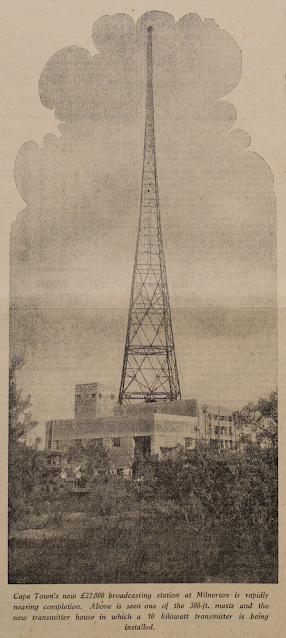
Cape Town’s new £22 000 Broadcasting Station at Milnerton

 CAPE TIMES - 1933, July 18 The Cape and Peninsula Broadcasting Association started Cape Town’s first Broadcasting Station on September 15, ...