Showing posts with label Japan. Show all posts

Monday, 25 November 2019

Motor Vehicles in Japan


CAPE ARGUS - 1906, December 29
The motor vehicle has invaded the land of the rising sun, but Japan is far from being an ideal country for the modern vehicle. The roads (says the Industrial Motor Review) are as they have been for centuries, designed only for the most primitive traffic and with the same economy of space which is everywhere manifest. The city streets as well as the country roads average less than 25 feet in width. People and vehicles mix indiscriminately, and look out for themselves as best they may. A 25-feet street is considered a wide one. In many places a motor vehicle with a top would be compelled to put it down rounding a corner, to keep from knocking down awnings. An attempt was made some time ago to have the streets widened, but the inhabitants indignantly protested, because if this took place, they could not walk the centre of a business street, and view the shop windows on either side. The streets of the towns are bad, but those of the country are worse. Many are not six feet wide. Between Nogaya and Kobe there are about 150 miles of fairly good roads, but there are three large rivers to cross, and to make things worse there are no bridges. To read the foregoing remarks one would think that prospect of introducing the motor vehicle to such a country is remote. But the fact is otherwise. Motor vehicles of all descriptions have been introduced, and their number is constantly on the increase. It is an old axiom that the Japanese do everything backward. Here is one example: In other countries the touring car has been the forerunner of the utility vehicles, but in Japan it is reversed – the industrial motor vehicle has taken the precedence. The Japanese have long been chiefly dependent for transport on what they call abbreviately “rich-shas.” Therefore, it is evident that such a condition of offers a wide field for motor buses. The first company that took up the introduction of industrial motor vehicles with serious intent was Osaka Jidoska Kaisha, to operate in Osaka. Seeing that there was a future in Japan for motor vehicles both for passengers and goods, a large order for chassis was placed with an American firm. The bodies of these chassis were made in Japan. The company started out with the utmost care and conservatism. It hired as head mechanic a young man who had been educated in Glasgow. An expert from America was also employed.

Saturday, 12 October 2019

Cape Wool Export


CAPE TIMES - 1924, April 8
On a business and pleasure trip, Mr. JM Gilfillan, of Gilfillan & Page Ltd., a big London firm of wool importers, arrived by the Armadale Castle yesterday. Interviewed by a representative of the “Cape Times” on the wool position in Europe, Mr. Gilfillan said that all grades of wool were in a strong future; while the financial position of the wool trade, about which fears were entertained in the latter part of last year, no longer gave rise for any uneasiness. In spite of the high prices now being paid for all classes of wool traders and manufacturers seemed well able to finance their obligations. “During the past season,” he continued, “a fair quantity of better class Cape wools have been catalogued at the London auction sales, and these have commanded high prices. The grading and breeding of your wools of late years, I must say, mark a noticeable advance; and it is quite evident that if the farmers continue to put back into bloodstock a proportion of the high prices they are getting, then the prestige of South African wool on the European markets will indeed rise to a very high point.”
CONDITIONS IN GERMANY
Asked with regard to the position of Germany as a buyer, Mr. Gilfillan replied that economic conditions in that country had become much more settled since the advent of the Renten mark; and although everything at present was excessively dear, the uncertainty brought about by the wild fluctuations of the old Reichsmark was disappearing; and trade was assuming more normal conditions.
Nevertheless, he added, the great bulk of German traders and manufacturers had not yet regained full confidence in the new currency, for Amsterdam and London still held in their respective currencies a vast proportion of Germany’s trading capital.
“For wool in particular,” continued Mr. Gilfillan, “the German demand is enormous, particularly in the classes produced by South Africa and Australia, which are the most suitable for their trade. For these wools, all through last season, they have been paying enormous prices, defying all competition from France and Bradford, paying cash down in English money, and wanting to keep their mills running. Nobody can stand up against them.”

At a Wool Sale in Cape Town in October 1939, 3 312 bales were offered. Mr. W. Young, chairman of the Cape Town Wool Exchange, stated that the market was firmer and the competition keener, especially from American and Japanese interests.
(CAPE ARGUS - 1939, October 30) 


Read more about the crisis Wool Producers had to face earlier this year, and how this problem has been solved.

Saturday, 20 July 2019

SHOES made of INSECTS

THE CAPE TIMES – 1933, 10 August

Japanese had perfected the process for making shoes out of BAGWORMS, according to this small article.
Bagworms (Family Psychidae) are interesting little creatures found in almost every part of the world. They are shaped like a cigar and about an inch and a half long. Bagworms construct their protective cases from things like soil, sand, silk and plant materials, and the case itself is attached and hanged on the surface of rocks or trees using their silk. Male bagworms leave their protective cases when they reach adulthood and become moths. Female bagworms remain inside their cases waiting for males to breed with them.


Interesting that this article was confirmed in POPULAR MECHANICS MAGAZINE (March 1933). They mentioned that Bagworms, one of the commonest of American insect pests, were going to be used for making shoes, purses and other articles. Apparently, a quantity of bagworms had been shipped to Japan from South Africa, and it is this type of insect, larger than either the American or Japanese varieties, which the Japanese hoped to use.  

Aki Inomata, a Japanese artist, tasked BAGWORMS with something a little different. She provided them with scraps of fabrics, allowing them to fashion their cocoons into unconventional fabric habitats. 

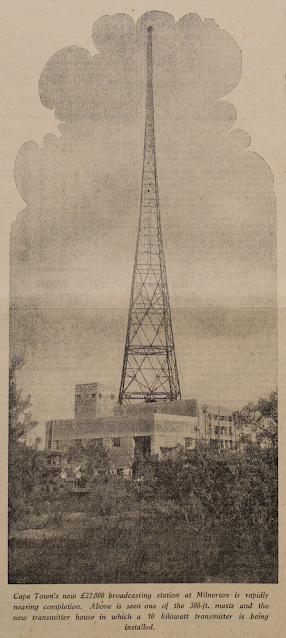
Cape Town’s new £22 000 Broadcasting Station at Milnerton

 CAPE TIMES - 1933, July 18 The Cape and Peninsula Broadcasting Association started Cape Town’s first Broadcasting Station on September 15, ...