Showing posts with label USA. Show all posts

Thursday, 30 January 2020

How the S.O.S. Call Originated


CAPE TIMES - 1924, May 27
The origin of the distress signal of ships at sea, now familiar to most people, has always caused considerable curiosity. The first suggestion of a distress call for ships was made by the Italian delegates at an early conference on wireless telegraphy, held in Berlin in 1903. These delegates urged the adoption of a universal signal, “SSSDDD,” to be sent by ships in distress. Shore stations and other ships, upon picking up such a signal would then stand by for further messages and suspend other communication immediately.
The final decision to adopt such a signal, however, was left to a special conference, but before anything came of it the Marconi Company, recognizing the need for a distress call, instituted on February 1, 1904, by general order, the famous call, “CQD,” on all their ships. This signal was a combination of the general call “CQ” coupled with the letter “D” to signify distress.
Only by the order of the captain of a ship in distress could it be used, or by a station retransmitting the signal. All stations were to recognize the urgency of the call and make every effort to establish satisfactory communication without delay. Several countries, including the United States, adopted “CQD,” and used it until the Berlin regulations were ratified.
A GERMAN SUGGESTION

At the Radio Telegraph Conference held in Berlin in 1906, the German government submitted a suggestion “that the ships in distressed will make use of the following special danger signal: . . . ― ― ― . . . (SOS).
Previously, German ships desiring to communicate with all vessels in their proximity, without knowing the names of calls, would send an inquiry signal, “SOE.” Germany planned to suggest this signal as the international signal, but as the last letter “E” represented in Morse by a single dot, was not believed sufficiently characteristic, the delegates in 1906 suggested the final letter as “S,” thereby having the honour to define what became the universal signal.
Whilst interpretations such as “Save Our Souls” and “Save Our Ship” should be accepted with reserve, there is this about it, that if these interpretations are not true, they are cleverly invented. In a similar manner the literal translations offered for “CQD” were
Come Quickly, Do,” and “Come Quick! Danger!”
The distress signal “SOS” was adopted officially and put into effect by the International Radiotelegraphic Convention of Berlin in July, 1908.
It was naturally a matter of keen regret to the Marconi operation that their old signal “CQD” was not adopted, and many continued to send “CQD” as well as “SOS” when accidents occurred. “CQD,” however, was gradually forgotten. In 1912 the USA adopted “SOS” when the international agreement was accepted.
It is pointed out that the signal today is “SOS” without space. The Morse man will readily understand the difference. 

Thursday, 31 October 2019

American Airship Disaster

CAPE TIMES - 1933, April 5

Disaster has befallen the Akron, greatest airship in the world and pride of the United States Navy. She is believed to have been struck by lightning during the night off the New Jersey coast. At any rate she crashed into the sea with 77 officers and men aboard and sank, after drifting for some hours, a hopeless wreck. So far, one officer and three men have been rescued, and one of these, the wireless operator, has since died.


THE STAR Johannesburg - 1933, April 4
The world’s largest airship, the United States naval dirigible AKRON, is reported to be a wreck off the New Jersey coast. Naval officials believe the airship was struck by lightning. Admiral WA Moffett, Rear-Admiral Berry and Rear-Admiral Cecil, the last 2 commanding officers of the Naval Air station, are among the complement of 19 officers and 57 men on board. Only the chief officer, Commander Wiley, and 3 of the crew are known to have been saved, and the Lakehurst Naval Station telephones that chances of saving the remainder are slight.
THE LAST RADIO MESSAGE
The last wireless communication with the Akron was at 10 o’clock last night, since when thunderstorms have interfered with messages. The Akron landed in the sea near the Barnegat lightship, and a German tanker, the Phoebus, was the first on the scene. The Phoebus rescued the chief officer and 3 of the crew, but the master thinks the remainder were lost. Four coastguard vessels, a cruiser, a destroyer and all craft in the vicinity are rushing to the scene of the disaster, where the wreck of the airship is reported to be afloat still. It is impossible to send an aeroplane owing to a “ceiling” of only 300ft and bad visibility.
Admiral WA Moffett has been the driving force behind America’s enthusiasm for lighter than air craft. From the day when the 2R3, given to America under the reparations agreement, made her historic trip across the Atlantic from Germany, Admiral Moffett has been an advocate of airships as the dreadnought of the skies.
The Akron expressed his ideal, for it had an armament of 16 guns and carried 5 aeroplanes inside the hull. These were equipped for screening the dirigible with smoke or for concerted attacks on enemy warships. The Akron, or ZRS4, was given into the charge of the United States Navy by its constructors, the Goodyear-Zeppelin Company, on August 8, 1931, and the occasion was one of great national rejoicing.
HUGE CAPACITY
The Akron was only a few feet longer than the German giant, the Graf Zeppelin, but it had a gas capacity of 6 500 000 cubic feet, or almost twice that of the Graf Zeppelin. It had a diameter of 133 feet and a lift capacity of 91 tons. The use of helium which is non-inflammable and non-explosive, permitted the incorporation of several new features. Former airships found it necessary to house their engines in gondolas suspended away from the hull itself to avoid the danger of explosion, but the Akron’s eight motors were housed inside the hull, which reduces parasite drag to a minimum. The Akron was 785 ft. in length and the frame of the vessel was made of duralumin to provide lightness and strength. There were 10 000 000 individual numbered parts, 54 000 tiny flat braces and 6 500 000 rivets. The deadweight of the airship empty was about 100 tons.
SEVENTH DISASTER
The crash of the Akron makes the seventh airship disaster since 1921, states the London correspondent of The Star. In February of that year the American dirigible, Roma, exploded at Hampton, Virginia, and 34 people died of injuries. On August 24, 1921, the ZR2 collapsed and exploded over Hull and 42 were killed. The French airship, Dixmude, German-built, was mysteriously lost in a gale with 30 men on board in 1923. The American airship, Shenandoah collapsed in a thunderstorm on September 3, 1925, and 14 were killed. On May 25, 1928, General Nobile’s airship, the Italia, crashed at North Spitzbergen and 14 were killed, and 3 would-be rescuers also lost their lives. 3 years ago, the British airship R101 exploded at Beauvais, France, and 46 were killed.
CAUGHT IN STORM
In May, 1932, the Akron fought a terrific battle with a storm over California, and when attempting to land afterwards broke 3 times from the moorings. 3 youths were hauled into the air clinging to the mooring ropes. 2 fell 200 feet and were killed. The other was rescued after dangling in the air for 3 hours.
REPORT BY MASTER OF THE PHOEBUS
Latest messages received from the German tanker Phoebus indicates that most of the crew of the Akron are lost. The Master of the Phoebus describes how he found mattresses and wreckage floating on the water. He rescued 3 men and saw 3 other men sink before his rescue party could reach them. He describes a thunderstorm and lightning, which might have struck the Akron. He suddenly caught a glimpse of the aircraft with her lights flashing on the water, and he heard men hailing him.
He turned on all the ship’s lights and put out lifeboats towards the dimly discernible lumps of the wreckage. Reuter, New York


More interesting facts about the USS Akron:
The USS Akron was commissioned in October 1931 and had its maiden voyage on November 2, 1931. During a full-blown thunderstorm during the night of April 3-4, 1933, the ship crashed into the stormy Atlantic. Sadly, of the 76 people on-board, most had died of exposure or drowning in the turbulent and freezing cold sea. Incredibly, the Akron had not been equipped with life jackets.
The role of the Akron was to scout for enemy ships and submarines.
It was 785 feet long - over 3 times longer than a Boeing 747 airliner.
Nearly seven and half million cubic feet of volume was displaced.
It had four starboard propellers and the engines’ water reclaiming devices appear as white strips above each propeller.
The emergency rear control cabin was visible in the lower fin.
It could carry up to five small fighter-reconnaissance aircraft.
The plane was launched and retrieved via a trapeze-style mechanism.
Bristled with 8 heavy machine guns, it had a crew of 60.
Range of nearly 7,000 miles. 
With a top speed of 79 miles per hour, it was twice as fast as the latest American Lexington-class aircraft carriers.

Tuesday, 20 August 2019

Origin of Tyres

CAPE TIMES – 1933, August 18
Where did the name "TYRE" come from?
The origin of the name “tyre” is shrouded in antiquity. There are at least two theories as to its derivation. One traces it to the Phoenician city of Tyre.
When Alexander the Great entered this city in 332 B.C. his war chariots were equipped with wooden wheels bound with iron or bronze. But here Alexander found other chariots magnificently constructed and reserved for the pleasure of the rich. He was impressed with the wheels on the pleasure chariots which had, secured by thongs to the bronze rims, an outer rim of leather.
This is the first known use of a tyre for reducing vibration and thereby promoting the comfort of the passenger, although, when Tutankhamen’s tomb was opened up by Lord Carnarvon and Mr. Howard Carter, the remains of a chariot were found, with wheels which, to all appearances, had carried some form of tyres.
Leather tyres were soon introduced into both Greece and Italy and even though iron and bronze wheel-rims had been in use for centuries before Alexander’s day it is just possible that the word “tyre” originated from the Greek or Latin name of this Phoenician city where this early cushion tyre is said to have been used.
Another theory favours a British origin. In ancient Britain it is said, the iron rims that bound the wooden cart wheels were called “tie-ers.”
In 1845 R. W. Thompson, a Scots road locomotive engineer, invented the first air-inflated tyre, which was laced or bolted to the carriage wheel. It consisted of plies of canvas saturated with rubber, but failed as the rubber was not vulcanized.
Forty years passed before anyone again gave serious thought to the possibilities of pneumatic tyres. But during this interval solid rubber tyres were generally used on bicycles and carriages and in 1884 Macintosh introduced the cushion tyre. This tyre, with a succession of cavities in the form of a spongy mass in the centre, was more resilient and was adopted at once for carriages.


THE STAR Johannesburg - 1918, February 28
Then in 1888, as recently described in The Austin Magazine, John Boyd Dunlop invented the first practical pneumatic tyre. So many inventors set to work to improve on J.B. Dunlop’s idea that for the next few years the Patent Offices in both England and the United States were deluged with applications.
Sometime antecedent to 1895 Dunlop motor tyres first appeared and in that year Dunlop 30 in. x 6¼ in. motor tyres were in use. With the Dunlop tyres of 1902 a foot pump and repair outfit were supplied! Incidentally, the minimum tyre pressure advised was 75 lb. per square inch!
In France the pneumatic tyre was first adopted for the motor-car in the early nineties, by the Michelin brothers, who unable to adapt the new type of tyre to their cars, actually built a car to fit the tyres. Though their first experiments were discouraging, by 1896 their pneumatic motor-car tyre was on the market. 

De Volkstem - 1925, 8 October

From that time the improvement of motor-car tyres kept steady pace with car improvements. The first effort to overcome skidding, which frequently occurred with the smooth rubber threads, was the invention of a leather thread studded with steel rivets and vulcanized to the rubber tyre. Then came the moulded rubber non-skid thread more or less as we know it today. The first cord tyre was invented in 1893 by John F. Parmer, of Chicago, and was at that time a bicycle tyre. Some time later a cord tyre for electric automobiles was introduced known as the “Power Saver.” Later came the cord tyre for motor-cars, which has now replaced entirely the square woven fabric tyre of all types. The cord construction, which employs cords laid to the inflated shape of the tyre cover, so that no internal stresses are set up when the tyre is fully inflated, is used throughout the world today, and is actually the same as that used in the “Power Saver” tyres of 25 years ago. 
(G.J. Joint in Austin Magazine)

CAPE ARGUS - 1918, November 8

THE STAR Johannesburg - 1918, March 7


Monday, 10 June 2019

WILLYS-Overland in South Africa since 1918

CAPE ARGUS (1918, November 16)
THE STAR Johannesburg (1935, August 5)
THE STAR Johannesburg (1938, January 6)
FIAT CHRYSLER AUTOMOBILES (FCA) is best known in U.S. for the company behind JEEP and RAM trucks. According to @kirstenkorosec FCA and RENAULT are discussing proposals to combine businesses - an illustration that automakers desire to consolidate to bring next-generation technologies like self-driving cars to market. 
Interesting to see that WILLYS-OVERLAND "Big Four" has been in South Africa since 1918.
According to THE STAR Johannesburg (1938, January 6) as from January 1, 1938, the WILLYS Agency for Johannesburg was transferred from GRESHAM MOTORS (Pty.) Ltd. to FORSDICK MOTORS Ltd. FORSDICK MOTORS has since 1920 operated from Durban and has also handled CHRYSLER, PLYMOUTH, DE SOTO and AUSTIN cars and FARGO trucks.


Wednesday, 5 June 2019

ICE for sale in 1875?


CAPE ARGUS 
1875, January 6 & 1886, February 28
CAPE ARGUS - 1875, January 6

I’ll never take ice cubes for granted as we had a freezer for 3 years that could not freeze properly. Reading through a 1875 copy of THE CAPE ARGUS, I was amazed to see that one could buy ice in Cape Town in 1875, and I decided to learn more about the refrigeration process. 
From Antiquity WINTER ICE was stored in insulated caves, principally for cooling drinks in summer. Since ice was used for the preservation of fish, meat and dairy products, ice production became an important industry in the northern states.
Lake and river ice had been cut by horse-drawn saws and by 1880 there were about 160 large ice-houses on the Hudson River. India produced ice by putting water in porous clay dishes on straw. During the night water evaporated so rapidly that ice formed on the surface of the water. The principle of the evaporation of water from the porous lining of the food compartment was used for refrigeration. In 1834 a method of artificial ice production was patented in England. Concentrated sulfuric acid, which absorbs water, accelerated the evaporation of water in a dish to freeze the remaining water. In the 19th century several types of refrigeration machines depended on the absorption of heat by expanding gases, which had been a subject of scientific research in the previous century. The vapor compression system replaced the early designs. The principle of the modern refrigeration machine is based on the circulation of a volatile fluid while being alternately condensed (with the evolution of heat) and evaporated (with the absorption of heat). 

CAPE ARGUS - 1886, February 28


Saturday, 1 June 2019

The "STONE FOREST" of NEW YORK

THE STAR Johannesburg - 1938, 1 January 


A view from the sea of the 'Stone Pinnacles' of the Wonder City of New York. The liner passing the Statue of Liberty is the Queen Mary.


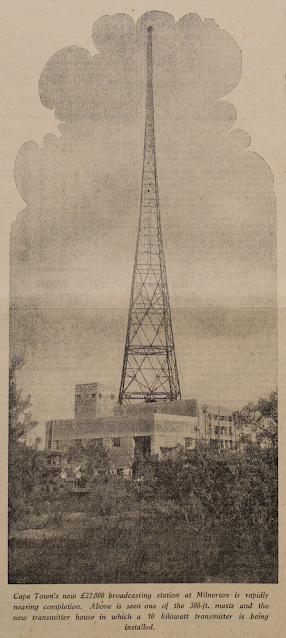
Cape Town’s new £22 000 Broadcasting Station at Milnerton

 CAPE TIMES - 1933, July 18 The Cape and Peninsula Broadcasting Association started Cape Town’s first Broadcasting Station on September 15, ...