Showing posts with label Shakespeare. Show all posts

Tuesday, 21 April 2020

Animals of Myth and Legend


CAPE TIMES - 1933, July 6
Myths and fables, which in olden times were attached to birds and beasts, were traced to their probable sources by Dr. Walter Rose in a delightful address on “unnatural history,” containing much humour and scholarship, to the Sons of England Lunch Club yesterday.
Beginning with the UNICORN, Dr. Rose quoted from Timon of Atheus:
“Wert thou a unicorn, pride and wrath would confound thee and make thine own self the conquest of thy fury.”
And from Julius Caesar:
“Unicorns may be betrayed with trees, and bears with pits.”
THE UNICORN’S HORN
According to old writers, the LION and the unicorn were traditional enemies, and the former, on seeing the unicorn, lured him to a tree, into which in his fury the unicorn drove his horn, rendering himself helpless.
It was at one time believed that a cup made from a unicorn’s horn would betray the presence of poison, but no one seemed to have been inquiring enough to test this supposition.
In Dr. Rose’s opinion, the legend of the unicorn had its origin, not in the RHINOCEROS, but in the NARWHAL, the horn of which animal was used in trade. By an easy transition this horn could be imagined planted on the brow of a mythical horse.
It was interesting to see how old tales had introduced new words into the language. He instanced the expression “to give someone a licking” or to “lick into shape.”
This appeared to have its origin in the strange old belief that young BEARS were born without any shape. In Shakespeare’s play, Henry VI, Gloucester was compared to “an unlick’d bear-whelp,” and there were other references to a belief that a young bear was literally “licked into shape” by its mother’s tongue.
MERMAIDS AND HARPIES
Turning next to “our old friend the MERMAID,” Dr. Rose quoted from “A Midsummer Night’s Dream”:
“And certain stars shot madly from their spheres to hear the sea-maid’s music.”
In olden times, the idea of making composites of men and animals was a favourite way of peopling the world with strange forms; thus harpies; the mand and HORSE in the centaur, and the man and GOAT in the satyr. That being so, the imagination of creatures in the sea half-FISH and half-human was so obvious as to discount the inaccurate explanation of the seal and the dugong.
The SHREW – really one of the most harmless of animals – was imagined by people of a primitive day to be terribly poisonous; and it was believed that if it ran across the legs of a cow it would cause paralysis. A favourite old English oath was “be-shrew thee.”
Happily, there was an antidote. This was to sea up the unfortunate shrew in a hole in a tree, where it obviously died. Subsequently, when a cow became “paralysed” its limbs were brushed with a branch of the tree, which became known as a shrew ash.
The ancient belief of the PHOENIX, referred to several times in Shakespeare, was that when it felt it had lived long enough it built a fire in which it destroyed itself, leaving in the flames an egg which produced a new phoenix.
The PELICAN was believed of old to nourish its young with its own blood, one explanation of the fable being that, in denuding itself of feather to line its nest, the bird scratched its skin and bled.
The term “SWAN SONG”, now in common use, was derived from the belief that at the time of death a SWAN was endowed with the ability to sing as sweetly as any other bird. (“A swan-like end fading in music” – “Merchant of Venice”).
Shakespeare appeared to have had no knowledge of the reputed propensity of the OSTRICH for burying its head in the sand, but he was familiar with its remarkable digestion (“I’ll make thee eat iron like an ostrich and swallow my sword like a great pin” – Henry VI).
About the CUCKOO there had been many curious beliefs, one being that on hearing the first sound of the bird immunity from pain in the limbs was obtained by rolling in the dew. The KINGFISHER was used at one time as a weathercock. Thus, Shakespeare’s reference to “time servers who turn their halcyon beaks with every gale and vary with their masters.”
“CROCODILE TEARS”
The “precious jewel” in the head of the toad was probably, in Shakespeare’s meaning, its eyes; but there was an old English belief that the creature’s head contained a stone capable of extracting poison from wounds.
The expression “CROCODILE tears” was derived from a curious belief familiar to Shakespeare, for he made Queen Margaret say of Henry VIII that he was beguiled by Gloucester “as the mournful crocodile with sorrow snares relenting passengers.”
The idea seemed to be that a crocodile could assume grief until a sympathetic person, inquiring what the trouble was, came along to satisfy its inner needs. A parallel belief was that the crocodile, having consumed all of its victim but the head, would regard that remnant with tears.

Sunday, 23 February 2020

Shakespeare in Afrikaans

THE STAR Johannesburg - 1935, July 27
The first Afrikaans version of Shakespeare’s “Merchant of Venice” was produced last night at the Turffontein Dutch Reformed Church Hall by students of The Potchefstroom University College.
Mesdames Wood and Nel, who were responsible for the translation deserve credit for the high standard of their work, which abounds in appropriate and vigorous idiomatic renderings.
The acting on the whole was very good, though the enunciation was in some cases poor, due, perhaps, mainly to the speed with which many of the lines were taken. The length of the play necessitated this.
The production was significant in its reflection of the spirit of the great original not only in costume, acting and lines, but also in setting the stage having been arranged on much the same line as the open one of Shakespeare’s day.
Mr. JC Coetzee, if somewhat extravagant at times, filled the part of Shylock well, and Miss L le Ches, as Portia, was the outstanding player of the evening. 
Others who deserved special mention were Mr JP du Toit, as Gratiano, and Mr AW Muller, as Bassanio.
Good though they were, some players would add to the quality of the production if their bearing and general deportment reflected more of the quiet, genteel dignity of the Venetian noble of the period.
Last night’s performance was the first of a series that will entertain audiences throughout the Northern Transvaal.

Friday, 26 July 2019

Proudly South African in 1918 and 1925

DE VOLKSTEM - 1925, 31 December 

THE STAR Johannesburg - 1918, 27 March

Shakespeare said: 
“There is a tide in the affairs of men which, if taken at the flood, leads on to fortune.” 
After years of fighting for a position against markets of the world, 
there was a tremendous boom in South African products in 1918 and 1925..


DE VOLKSTEM (an Afrikaans newspaper) had an advertisement on 1925, 31 December, to stress the importance of spending money on items that were manufactured locally. By doing this, more jobs would be created, the cost of living would be reduced and taxes would be lower. Good citizens should do this in the interests of our country.


SPRINGBOK SHOE STORE advertised their excellent shoe-ware - a first for South Africa, promising shoes as good as any imported shoe. 
(DE VOLKSTEM - 1925, 8 October)


Sturdy Furniture - made in South Africa by South Africans!
Solid oak and color-resistant fabrics that would not fade, were used. 
(DE VOLKSTEM - 1925, 8 October)


After years of fighting for a position against markets of the world, there was a tremendous boom in South African made Footware. Productions absolutely equaled the imported shoe at half the price of shoes from England. (THE STAR Johannesburg - 1918, 10 January)


Economic Boot Store was proud to announce South African Made Footwear for the Whole Family. (THE STAR Johannesburg - 1918, 5 February)
In an economic downturn of ever-increasing costs, now is the time to buy Proudly South African, as your contribution can help build the local economy. The Proudly South African initiative was launched in 1998 by former President Nelson Mandela at a presidential summit to promote South African job creation opportunities through local investment in products and services. By buying mainly South African products and supporting local companies, you can directly/indirectly make a massive contribution to the country's economic stabilization and progress. South Africa's unemployment rate will not improve at all if we only import and disregard local products.
Local business owners are encouraged to register as a member of the Proud SA initiative to introduce the well-known emblem to their products, website or corporate stationery. Citizens and tourists can then observe it at first glance and make informed choices when deciding on purchases or service. As a business's existence depends on regular orders and good payers, special attention should be given to do-it-yourself items, clothing, food and cosmetics: general consumption items.
Do your homework, make a decision for all of us and buy proudly South African today! Remember, your contribution and support to the South African manufacturing market as such is an investment in your children and grandchildren's future job opportunities.

Kindly read Tania Du Toit’s interesting post on https://finansies.solidariteit.co.za/hoekom-jy-suid-afrikaans-moet-koop/


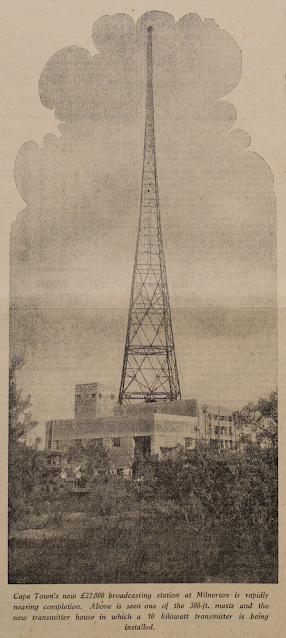
Cape Town’s new £22 000 Broadcasting Station at Milnerton

 CAPE TIMES - 1933, July 18 The Cape and Peninsula Broadcasting Association started Cape Town’s first Broadcasting Station on September 15, ...