Tuesday, 24 December 2019

The Message of Bethlehem is a Message of Hope


CAPE ARGUS - 1939, December 9
FAMOUS POEMS ABOUT – Rev. Robert Barr
For almost two thousand years poets have been making pilgrimage to Bethlehem. In the immortal story of the Babe, Joseph, Mary, the angels, the shepherds, and the wise men, they have found a theme worthy of their genius.
The Cradle and the Cross have inspired more poetry and song than any other phase of Christ’s life and of these two, the Cradle has inspired the more. In most hymnaries more space is given to the incarnation than to the sufferings and death. Not that the latter is less important than the former, but simply because a birth has always been more full of light than a death. In a story so rich in material, poets have had emphasized different aspects of Bethlehem. This has resulted in a very varied and a very rich treasury.
QUAINTLY AND BEAUTIFULLY
The poverty of Bethlehem has appealed to many poets, and they have made it the theme of their poems. Robert Southwell puts this thought quaintly and beautifully.
The Inns are full, no man will yield This little Pilgrim bed;
But forced is He with silly beasts In crib to shroud His head.
Despise Him not for lying there, First what He is inquire;
An orient pearl is often found In depth of dirty mire.
Weigh not His crib, His wooden dish, Nor beasts that by him feed;
Weigh not His mother’s poor attire, Nor Joseph’s simple weed.
A STABLE WAS THY COURT

Henry Vaughan, seventeenth century physician and poet, dwells on the same thought, the poverty attendant on the Nativity.
A stable was Thy court, and when
Men turned to beasts; beasts would be men;
They were Thy courtiers; others none;
And their poor manger was Thy throne.
No swaddling silks Thy limbs did fold,
Though Thou couldst turn Thy rags to gold;
No rockers waited on Thy birth,
No cradles stirred, no songs of mirth.
John Mauburn, a sixteenth century poet, expressed a similar thought in Latin verse. Elizabeth Charles has translated it:
Dost Thou in a manger lie.
Who hast all created, Stretching infant hands on high.
Saviour long awaited? If a monarch, where Thy state?
Where Thy court on Thee to wait? Regal purple where?
Here no regal pomp we see.
Nought but need and penury. Why thus cradled here?
Alice Sewall, writing towards the close of the nineteenth century, draws attention to the poverty surrounding the Nativity with a charm that would have done credit to the best of the Elizabethans.
The night was darker than ever before (So dark is sin)
When the Great Love came to the stable door And entered in,
And laid Himself in the breath of the kine, And the warmth of hay,
And whispered to the star to shine, And to break, the day.
Alice Meynell, who lived into the beginning of our own century, sings of the lowliness of Christ’s birth with all that delicacy of spiritual insight which marks so much of her poetry.
No sudden thing of glory and fear Was the Lord’s coming; but the dear
Slow nature’s days followed each other To form the Saviour from His Mother –
One of the children of the year.
THE PEACE OF BETHLEHEM
While many poets have been drawn by the poverty of Bethlehem, many have been drawn by the peace of Bethlehem. John Milton has interpreted this as only he could have done in his “Ode on the Nativity.”
No war, or Battails sound, was heard the world around,
The idle spear and shield were high up hung;
The hooked Chariot stood Unstained with hostile blood,
The Trumpet spake not to the armed throng.
And Kings sate still with awful eye, As if they surely knew  Their sovran Lord was by.
But peaceful was the night Wherein the Prince of light
His reign of peace upon the earth began;
The Windes with wonder whist, Smoothly the waters kist,
Whispering new joys to the milde ocean, Who now hath quite forgot to rave,
While Birds of Calm sit brooding on the charmed wave.
PEACE IN NATURE
The poets have felt that the angel’s message of peace was responded to immediately by a strange unwonted peace in Nature.
Here is how Edward Thring expresses it:
Holy night, by thy solemn silence evermore enfoldeth
Angel songs and peace form God on high;
Holy night, thy watchers still with faithful eye beholdeth
Wings that wave, and angel glory nigh,
Lo! Hushed is strife in earth, and air, and sky;
Still thy watchers hear the gladness of the cry.
George MacDonald in his poem “The Sleepless Jesus” wrote:
When first Thou camest to the earth, All sounds of strife were still;
A silence lay about Thy birth, And Thou didst sleep Thy fill.
Frederick Farrar, teacher, preacher and poet of the nineteenth century, also dwelt on the peace of the Nativity:
And the shepherds came to the manger, And gazed on the Holy Child;
And calmly o’er that rude cradle The virgin mother smiled
And the sky in the starlit silence, Seemed full of the angel lay –
“To you in the city of David A Saviour is born today.”
Phillips Brooks opens his well-known hymn with this thought – the peacefulness of the Nativity.
O little town of Bethlehen, How still we see thee lie;
Above thy deep and dreamless sleep
The silent stars go by; How silently, how silently
The wondrous gift is given! So God imparts to human hearts
The blessings of His heaven.
STRESSED ITS PROMISE
But while many note the poverty of Bethlehem, and many note its peace, others have stressed its promise. They see in the Birth at Bethlehem the dawning of a new word of hopes for mankind. GK Chesterton sings of all that the coming of that Child has meant to the human race.
The thatch on the roof was as golden, Though dusty the straw was and old,
The wind had a peal as of trumpets. Though blowing and barren and cold,
The mother’s hair was a glory Though loosened and torn,
For under the eaves in the gloaming A child was born.
And the rafters of toil still are gilded With the dawn of the star of the heart,
And the wise men draw near in the twilight Who are weary of learning and art.
And the face of the tyrant is darkened, His spirit is torn,
For a new King is enthroned: Yea, the sternest, A child is born.
Bernard Trotter has set this thought of the promise of Bethlehem in a very striking poem.  
A star came out of the East, And a dream came out of the West.
They thought that the Star would set, They dreamed that the Dream was best.
The dream of an Empire’s Vast As the world’s night-bordered hem.
The star of Eternal Love – They met at Bethlehem.
And the Dream became a star, That fell through the night, and died;
But the Star became a dream, Fulfilled through aeons wide.
George MacDonald expresses the idea appealingly in “That Holy Thing.”
They all were looking for a king To slay their foes and lift them high:
Thou cam’st, a little baby thing That mad a woman cry.
O Son of Man, to right my lot Nought but Thy presence can avail;
Yet on the road Thy wheels are nought, Nor on the sea Thy sail!
My how or why Thou wilt not heed, But come down Thou wilt not heed,
But came down Thine own secret stair, That Thou mayst answer all my need,
Yea, every bygone prayer.
THIS IS THE MESSAGE
And this surely is the message of Bethlehem and Christmas to our baffled and perplexed world – a message of Hope. Our Hope is in the child of all Eternity who was born at Bethlehem. No man or woman can make a pilgrimage to the Manger without turning away again filled with hope. Let all of us, young and old, find time to go in thought and praise to Bethlehem this Christmas, and there be renewed in hope. And all may make the pilgrimage, for, as Honoria Traifle sings:
The path to the stable where lies the Babe, Is wide indeed;
For rich and poor there tread alike, in common need.
The path to the stable is very worn, by countless feet,
From vale and hill, from forest depths and city street.
The path to the stable is very old Yet never overgrown;
A little child could find his way, though all alone.
The path to the stable is known by kings, And beggars too;
And just by folk who love the Babe Like me and you.


Wednesday, 18 December 2019

MOSSEL BAY News – 1886, 1933 & 1939

CAPE TIMES – 1933, July 8
The Poort, Mossel Bay
The Mossel Bay Municipality, now that it has hired the foreshore from the Harbour Administration, will be able to carry out its improvement plans which it has had under consideration for the past 20 years. Above is a view of the Poort, the fine natural bathing pool, which is one of Mossel Bay’s principal attractions.

Read more about the tidal pool at  https://www.gardenroutemeander.co.za/garden-route-klein-karoo/natural-attractions-gr/natural-attractions-rock-pools/the-tidal-pool-blougat-mossel-bay-garden-route-south-africa-2830.html


Goedemoed Farm, Mossel Bay
CAPE TIMES - 1886, August 7
The Insolvent Estate of Helgart Muller, GOEDEMOED in the Mossel Bay District, will be sold by Public Auction on Tuesday, August 17, 1886. Mr. TS Sheard will be the auctioneer.
This splendid, valuable and well-known farm is situated about 12 miles from Mossel Bay. It is some 2 400 Morgen in extent, has Plentiful Supply of Water and Extensive Arable Lands. As a Cattle, Sheep and Ostrich Farm it is unsurpassed, and the Homestead and other Buildings are large and in an excellent state of repair. 
Among the Live-stock, Household Furniture and other Movables, which will be sold at the same time, may be specially mentioned 14 fine Horses and Mares, about 400 Sheep, a well-bred Bull, 13 Ostriches, Oxen, a large Wagon, Carts, Blacksmith’s Tools, etc.
ER Syfret & S Short are Joint Trustees.


Mossel Bay Aerodrome
CAPE ARGUS - 1939, February 1
Aerodrome opened: Mrs. Fourie, mother of Senator APJ Fourie, Minister of Railways and Harbours, cutting the ribbon at the official opening of the Mossel Bay aerodrome.


Wednesday, 11 December 2019

Robertson - an Example for other South African Towns


CAPE ARGUS - 1927, August 4
EDUCATION
Educationally, Robertson has excellent facilities. There are two high schools, one for boys – a large, modern and exceptionally well-equipped building in Education Street, with two boarding establishments, McGregor House and De Waals Hostel – and one for girls, an equally up-to-date building, with a domestic science block in Reitz Street. The school stands in large grounds and a short distance further up in the street is a hostel for girls, capable of accommodating some 70 boarders, and named Merwehof after Dr. Van der Merwe, the late Moderator of the Dutch Reformed Church. Both the boys and girls’ hostels are roomy and airy, and surrounded by recreation grounds.
Each school has some 300 pupils and, in addition to preparing students for the usual matriculation course, they give special facilities for instruction in music. Students are prepared for the licentiate diplomas in piano, violin, organ and singing. The two teachers of singing have London diplomas and pupils are sent to Robertson from all over the country. A feature of the instruction in the boys’ school is the agricultural course. The work is specially arranged for each class and it is of a varied nature, including instruction and practical work in the many different agricultural pursuits for which Robertson is noted.
“MEESTER’S” FATAL MOUTHFUL
Tales of the “good old days,” when South African towns were in their infancy, invariably tell us what strict disciplinarians the old “skoolmeesters” were. Who has not heard of father’s schoolmaster whose “kweperstok” (quince stick) was never beyond reach? Such a martinet had the school going youth of Robertson in its early days. He was a Scot who freely employed a light, flexible cane of peculiarly searching qualities.
A certain grim humour attaches to the story of the occasion when the cane operated on the schoolmaster himself. At dinner one day he swallowed too large a piece of beef, which lodged in his throat, and all efforts to dislodge it proved unavailing. Whether a cynical pupil who had good reason to remember the cane suggested using the implement tradition does not say, but the fact remains that it was hurriedly fetched from the school, and employed to ram the obstinate piece of beef down!
First the unfortunate teacher tried, and then his landlord, but to no purpose. A doctor was summoned post-haste from Worcester but before he arrived that night poor “meester” had passed away. His name may be read today on one of the few weather-beaten tombstones that surround the Dutch Reformed Church.
FROM DERBY WINNER STOCK
One of the leading farmers in the Robertson district, is Mr. DJ de Wet, of Zandvliet, who specializes in racehorses and has just added to his stable a splendid stallion from the same stock as this year’s Derby winner. Mr. Chris de Wet, his son, is an expert on sheep, and recently procured in Australia for their merino stud stock a ram costing £2,000 and another costing £1,000, in addition to several stud ewes.
Some indication of the progress of stud sheep farming in Robertson district may be gained when it is stated that the breeders are competing successfully among other important at the Central Show at Bloemfontein with the sheep kings of the Midlands.
Among other important stud farms in the district are those of Mr. Paul de Wet, Zandvliet, noted for sheep; Mr. JS de Wet, Excelsior, for Frieslands; Mr. Gideon Malherbe, De Hoek, for Jerseys; Mr. Adriaan van Zyl, Boesman’s River, for Frieslands and Clydedales; Mr. Leo Visser and Mr. Dove, of Goedemoed, for sheep; and Mr. Bennie, of Bonnievale, for Frieslands. Poultry farming is largely carried on at Bonnievale, and cheese manufacturing is yet another resource exploited by the Robertson farmer. It may be remarked that Robertson is not a place where farmers sit in blissful contemplation of the shifting colours on the high mountains while nature does the job. The farmers there are as hard worked as farmers anywhere else in the country. They have their losses and their set-backs. They grumble about irrigation rates and the price paid for their products by the pampered consumer. But they are energetic and progressive, and will push their fine south-western district to enviable heights.
In Safeguarding public health, the Robertson Municipality sets an example which other South African towns might follow. Robertson’s town hygiene is something to be envied by other places – and it is due to the enterprise and strong personality of a woman. 
In securing the services as Woman Health Visitor of Miss M. Cilliers, a holder of the Royal Sanitary Institutes’ certificate, the Town Council took a forward step that has today given it a town which is almost model from the health point of view. Not that Robertson has any particularly modern and costly institutions designed from the point of view of public health. It is much simpler than that. A dynamic worker whom all Robertson hold in high esteem – if not a little bit in awe! – Miss Cilliers preaches – and enforces – the doctrine of individual effort. She sees to it that all concerned put first and foremost the ideal of keeping the town clean and healthy. Where food is prepared or kept for public consumption the premises are, under her watchful eye, maintained sweet and fresh. There is constant war on flies. All butchers’ meat is gauze protected and carried in covered wagons; the bakeries are places of fragrant cleanliness; the dairies are kept spotless, and the streets are always a public testimonial to Robertson’s health enterprise.
Miss Cilliers has a free hand in promoting public welfare interests. She is armed with the authority of a fine set of municipal regulations, and, besides that, per post is partly a Government one. But quite apart from that she has those outstanding personal qualifications and capabilities that spell success in work of this character. Miss Cilliers is an indefatigable worker. A trained nurse to whom responsibility is no novelty, she renders splendid services among the poorer members of the community, while she is constantly watchful that the ordinary public services come up to all health requirements.
Miss Cilliers started her work at Robertson less than a year ago. The means the adopted were simple but firmly moved to provide washable walls and floors for their premises and to cover their meat stands with wire gauze. Not satisfied with that, the Health Visitor got them doubly to protect their meat by also screening doors and windows with gauze. She pays them pretty frequent visits to see that everything is always in shipshape order.  Robertson’s bakeries invite a visit at any time. Gauze here, too, and, like the butchers, the bakers have covered in delivery vans.
One up-to-date place has appreciated the economy and healthfulness of machine-made bread and the Municipality is now preparing to erect a properly equipped abattoir. Here, there, and everywhere the Health Visitor speeds in her “flivver.” Nothing escapes her vigilance. No litter is allowed to accumulate anywhere. Yards and furrows, stables and streets, shops and general sanitation are always under critical inspection. Where the Health Visitor thinks something might be improved there is no gainsaying her!
It is in Robertson’s coloured quarter that the success of her work is most apparent. What Miss Cilliers calls her slum area is a portion of the town which has been converted from squalor and decay into a decent, habitable place. Numerous places which have been condemned by her have been bought in by the Town Council, or the landlords have been compelled to make the necessary repairs. Badly aired places have had to be supplied with ventilators, and, generally, every effort is being made to keep the coloured people living under normal, healthy conditions. They have a wholesome respect for “Nurse” and they keep their yards and houses fit for her inspection at any time. They have actually come to take a pride in this work and they even sweep the streets in front of their houses. They usually have a smiling greeting for the Health Visitor, the value of whose work among the sick poor they greatly appreciate.
Miss Cilliers’ effective methods have warmly commended themselves to the Town Council. Her work is highly valued and the Union Public Health Department’s latest report on Robertson is a well-deserved tribute to her ability.


Come to Robertson for your Holiday – Come to Stay

CAPE ARGUS - 1927, August 4
Robertson (but half-a-day’s journey from Cape Town) is most beautifully situated, with mountains surrounding. It is well laid out, and the scenery alone is worth a visit to Robertson. 
COMMERCE IN ROBERTSON
Dried Fruit Factories, Distilleries and Wineries form the major section of industrial activities. Robertson offers a splendid opportunity for a considerable industrial expansion.
SOCIAL LIFE IN ROBERTSON
The Dutch Reformed church is a feature of Robertson and well worth seeing. A Library and Reading Rooms provide for those of literary taste. Patrons of the Theatre will find the splendid bioscope and entertainment hall absolutely modern. Entertainers seldom fail to pay Robertson a visit, and the town does not lack in dances.
SPORT IN ROBERTSON
A fine recreation ground provides for Football, Hockey and Cricket. Tennis Courts, Croquet Court and a nine-hole Golf Course provide for those of other tastes. Boating, Bathing and Fishing in the Breede River, are within easy reach of the town. There is Mountaineering is the neighbourhood; the foot of most of the peaks is easily reached by motor.
CAPE TIMES - 1933, April 25


A PARADISE FOR PICNICKERS
Some delightful spots are within easy reach of Robertson by motor-car. There is, for instance, the De Hoop drive to the mountains – a winding way with farms clinging to the slopes of the foothills and nestling in the valleys. The scenery all the way is splendid and the traveler gains some idea of the remarkable fertility of the farms. From Burger’s farm it is a short walk to the waterfall. Robertson gets its drinking water supply from this spot, which with other places in the neighbourhood, is a magnet for picnickers. The grandeur of the Langebergen range dominates this part of the district.
Equally popular is the short drive to Dassies Hoek. From the town the road leads to a square-shaped cleft in the mountains known as the Window Ledge. Winding up the foothills in easy gradients, the motorist passes works where a good quality lime has been produced from the blue limestone of the mountain. From the top of a hill the farms of Dassies Hoek are seen perched on the mountain side and extending down the valley. But for the absence of chalets, the scenery is typically Swiss in character. At the river there is a poplar grove frequented by picnickers. Higher up is another waterfall which splashes into an almost circular canyon. The scenery here, as elsewhere on the slopes of the mountain chain, has a singular charm. From here a bird’s eye view may be had of the main features of the fertile and beautiful Garden district. A short and very pleasant little drive is the one through the Government plantations to the Silver Strand on the Breede River. Here a fine stretch of sand and safe boating and bathing are enduring attractions to town people. Robertson’s roads are good, and its scenic resources endless. Those who wish to go further afield than the spots mentioned may take the road through the smiling valleys down to the famous Cogman’s Kloof. Here, and at Zandvliet in particular, they will find farms second to none in South Africa. Robertson itself, it may be added, is an easy four hours’ drive from Cape Town. A more pleasant spot away from the hustle of the city could not be desired.

Friday, 6 December 2019

Ida’s Valley Homesteads


CAPE ARGUS – 1939, January 3
Stellenbosch was the favourite child of Simon van der Stel. He loved it for its beauty, its fertility, and the pleasing contours of its hills and valleys. He gave its name to the embryo village, and he granted land to several of his friends in the Ida’s Valley, most lovely of all the valleys, under the shadow of his own Simonsberg.
Several of the old homesteads still survive. Time has dealt with them kindly. One of these is RUSTENBERG, on the land granted to the Landdrost Peter Robbertz, who came to the Cape in 1696. The house is H-shaped, with white-washed walls, large, low windows, simple gables and a thatched roof. The curved steps leading up to the flagged stoep are made of tiny Batavian bricks, brought over by the Dutch East India Company at the command of the first owner. A grant of land nearby was made to the Huguenot exile, Francois Villon, of Clermont, in 1692; and he probably lived in an earlier house, traces of which may still be seen, near the present homestead of Ida’s Valley. The neighbouring farm of Schoongezicht, for long the property of John X Merriman, also has a charming house, built rather high up, with a view of the Stellenbosch valley.
RUNNING WATER
Every homestead in the valley has white-washed walls and a thatched roof, and is surrounded by oak trees and running water.
There sluits of water round the house are a tradition surviving from the old days when, in the summer-time, the slaves used to lay the dust around the house by scooping water out of the sluits with a tin dipper, and sprinkling it liberally over the road.
This is not the only thread left from the tapestry of past years. Everywhere are to be found signs of earlier settlers, and of their customs and way of life. At Schoongezicht wine is still made in the gabled wine cellar, and the grapes are still pressed out by human feet. At Rustenberg, the slave hole under the house is now used for the more prosaic purpose of storing logs of wood, but it is still very dark and mysterious. In the loft under the thatch apples and pears are spread out on straw to keep for the winter months. Thrifty Dutch housewives of a century or more ago kept their stores in much the same way, in the days before cold storage was though of, and they hung their bunches of herbs and their home-cured hams on the same broad rafters.
The old homesteads in the valley were built for coolness, with high ceilings, thatched roofs and large windows. All the rooms are large and rather draughty. Fireplaces are scarce, and it would need a roaring fire to warm those huge, airy rooms. It is supposed that earlier tenants just retired to bed with a large, copper warming-pan when winter frosts set in. Present owners installed fireplaces and plenty of electric heaters.
MODERN HOMES
Besides the old Dutch homesteads of Ida’s Valley, Schoongezicht and Rustenberg, there are some charming new houses in the valley, which have been built on bits of land cut off from the three original farms. One of these is Kelsey Farm, built on a hilltop above Rustenberg – a low-eaved thatched house with a peerless view and surrounded by vineyards. Another is the House in the Woods, built among the poplar trees on a piece of Ida’s Valley. Numerous other cottages have sprung up as more and more people have realized what a delightful part of the world this is in which to live. All are comely, with their thatched roofs and white-washed walls, and are in keeping with the spirit of the valley.
The grey curves of Simonsberg rise above the valley, which is watered by springs from its ravines. Among the rocks near the summit live a troop of baboons, which raids the upper farms for fruit and mealies when roots get scarce on the mountainside. On the very top is an old Hottentot cave, supposed to have been the refuge of runaway slaves. But one cannot help feeling that only a very foolish or very frightened slave would leave the comfortable life of the valley for the inhospitable mountain heights.
THE FAMOUS OAKS
If you read through the dispatches of Simon van der Stel, you will come across this letter the Landdrost, Ditmars, of Stellenbosch, dated July 13, 1701. “We send you, for the benefit of the Stellenbosch community, a wagon laden with young oak trees, which with the co-operation of the Reverend Hercules van Loon, are to be planted – wherever possible. They are at once to be put into the ground, lest they perish through delay.”
This accounts, in part, for the beautiful old trees to be found everywhere in the valley. It was part of the governor van der Stel’s policy to plant plenty of oak trees, and he guessed how well they would flourish in this fertile soil. At Rustenberg is a giant oak tree filled with stones and cement to hold it up, as its core has long since rotted. Yet it still produces its crown of green leaves every summer, and gives every indication of robust life. It must be more than a hundred years old, and many generations must have sheltered beneath its gnarled branches.
TREES OF MANY KINDS
Besides oak trees, there are poplar woods, delicate and silvery; tall rows of Lombardy poplars to shelter the orchards, which in autumn are a golden delight; avenues of plane trees and flowering gums; a silver tree plantation; Spanish chestnuts in sheltered gullies; wild olives and fir forests on the mountain slopes. At Schoongezicht a giant mulberry tree bears its yearly crop of crimson berries. At Rustenberg weeping willows droop delicately over the swimming pool, until they nearly touch the blue water-lilies below; and on their branches, weaver birds build their nests.
So far, I have not even mentioned the fruit trees – in Ida’s Valley one takes them for granted. Since the business of the valley is fruit, every bud is watched with care, every south-easter dreaded once the fruit has formed, and all market prices studied with apprehension. The busiest time of the ear is the fruit season, starting in December and ending in March or April, when the last pears and apples have been placed in their wood-wool nests in the fruit boxes and consigned to foreign ports or home markets, according to their size, quality and degree of ripeness. The summer months mean constant toil to the fruit farmer as his merchandise is perishable. It must be picked and packed at an exact stage of ripeness, and like time and tide, it waits for no man.
Yet it would be impossible to get any real sense of hustle in this valley of green trees and cooling streams. One feels that land may be bought and sold, men may come and go, and farmers may sweat to wrest a living from the soil; but the tranquility of the year will remain in Ida’s Valley – a snare for settlers, a benediction to the world-weary, and a constant tribute to the good taste of Governor van der Stel. – The Hon. Yvonne de Villiers

Tuesday, 3 December 2019

Cape Wines in 1886

CAPE ARGUS - 1886, May 31
There is a greater “potency of wealth” in the news that comes from London, of Cape light wines selling freely at the Exhibition, than in all the gold news with which we are just now being titillated. The news is intensely gratifying, and promises well for an ultimate return for the large sum (to us) which we have sunk in the Exhibition; but it is still more gratifying to hear, as we lately have heard upon the most competent authority, that there is really some excitement amongst the wine farmers themselves, owing to the complete success which has attended the venture of a few of their number who have tested Baron von Babo’s methods by preparing in each case just one or two vats according to his directions. The wine so prepared, is clear and of beautiful quality; far superior to anything to which the wine farmers have been accustomed. Next year every one who has made the experiment will have the whole of his vintage so prepared, so that should a demand be created for good Cape wine, in a short time we shall be in the proud position of having the article with which to meet the demand. It is needless to say that not only will those who have thus prepared part of their vintage next year devote the whole of their crop to the improved processes, but their neighbours, convinced of what can be done, will come over to the same ways, and thus there is a better prospect for the farmer, out of his own progress, than from any legislation which could be devised.

Monday, 2 December 2019

Garden Route Touring Tips


CAPE ARGUS - 1939, December 26
At all times of the year, but particularly in the summer, the Garden Route between Port Elizabeth and Cape Town makes a strong appeal to holiday makers and tourists. The thousands who will travel that way by road will find the following information by the A.A. concerning one of the alternative routes in this area of considerable interest.
Assuming the trip begins at Port Elizabeth the road via Van Stadens Pass and Gamtoos to Humansdorp will be found under construction. About nine miles beyond Humansdorp keep left for the coast road which passes Clarkson and then runs between the Tsitsikamma Mountains and the sea. This is good road practically all the way, but in case of heavy rain the route via Assegaibosch and Kareedouw Pass is recommended. There are good camping sites near Storms River and Coldstream, and at Plettenburg Bay excellent fishing and surfing can be obtained. A trip by motor launch on Keurbooms River reveals the fine scenery. The forest and the furniture factories at Knysna are worth visiting.
One of the Prettiest Towns
Continuing to the Wilderness careful driving is advised crossing Phantom Pass and Homtini Gorge. Reaching George – reputed to be one of the prettiest towns in South Africa – the tourist may take the road over Montagu Pass to Oudtshoorn. This road is moderately corrugated, with steep gradients and dangerous bends. There are many delightful motor runs in this vicinity; e.g. the Swartberg Pass to Klaarstroom and returning via Meirings Poort; while the famous Cango Caves and Bushmen paintings should not be missed.


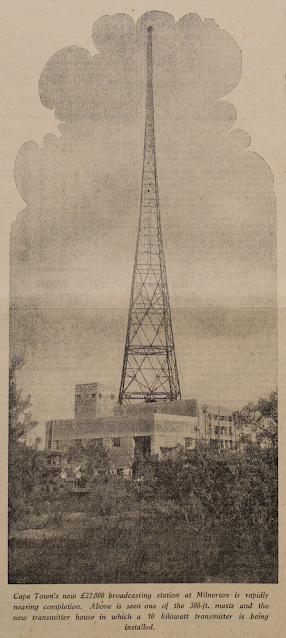
Cape Town’s new £22 000 Broadcasting Station at Milnerton

 CAPE TIMES - 1933, July 18 The Cape and Peninsula Broadcasting Association started Cape Town’s first Broadcasting Station on September 15, ...