CAPE TIMES - 1924, April 11
During the evening of 23 November 1923 people across Sydney gathered eagerly in their homes around pieces of wondrous new technology to hear the first radio broadcast in Australia.Watch this space for Archived Photos & Articles of News Events, Fashion, Sporting Events, Inventions, Architecture, Recipes and Advertisements of Vintage Cars, Liquor, Food, Medicine and Toiletries dating back to the Old Times of South Africa. Pardon the quality of some of the posts. The colour of some of the pages has somewhat yellowed. It is interesting that the older the paper, the better it has been preserved. I presume less chemicals were used in The Olden Days.
Sunday, 12 February 2023
First Wireless Broadcasting Station in Sydney, Australia
Sunday, 5 February 2023
Insurance of Animals in 1906
Friday, 3 February 2023
Snap, Crackle & Pop
When you want to give the children a light, but satisfying meal there’s nothing better than Kellogg’s Rice Krispies. Made from kernels of wholesome rice, they are toasted to a delicious golden brown – so light they snap, crackle and pop in cold milk or cream. Children and grown-ups alike enjoy their tasty flavor and crunchy goodness. Try them today. No cooking required. Sold by all grocers in the red-and-green packet.
Kellogg's Rice Krispies
New –
Different – Delicious
All the children
are excited about this new cereal – Kellogg’s Rice Krispies. So different from
anything you have ever known.
Lively little
bubbles of toasted wholesome rice, that SNAP, CRACKLE AND POP as they float
lightly on milk or cream. Get a packet today, mother, and give the children a
real treat. No trouble at all. No cooking.
Serve direct
from the packet with cold milk or cream. Sweeten with sugar if desired. At your
grocer’s in the red-and-green packet – always oven-fresh – protected by the
patented inner WAX-TITE bag. (
Monday, 30 January 2023
Eight-wheel Car (ADLER Diplomat)
THE STAR Johannesburg - 1935, August 16
A Berlin firm has produced an eight-wheel car, said to be virtually shock-proof and comfortable over rough roads at high speeds. The photograph shows the new car on a country road.The position of the front wheel illustrates how the car will avoid bumping. The wheels will pass over the holes in the road, and not into them.
Sunday, 17 April 2022
POLAROGRAPH: Device that Analyses Liquors
CAPE TIMES - 1933, August 19
DEVICE THAT
ANALYSES LIQUORS
Revealing Chemical Contents
Whenever liquors fall under the suspicion of not being what they are claimed to be, the use of an electrical device called a polarograph, which was invented in 1922 by Prof. Jarslav Heyrovsky of Charles University, Prague, will establish beyond doubt their guilt or innocence.
The Polarograph automatically analyses all kinds of liquids and solids, including the most complex chemical solutions, and thus saves hours of tedious work in laboratories. The solution to be analyzed is placed in a small container, in which it is electrolytically decomposed. Then by closing an electric switch the device automatically records on a strip of paper wound on a drum a graph in the form of a curved line which indicates both the relationship between the current passing through the solution and the magnitude of the electromotive force.
.png)
Prof.
Heyrovsky says that the use of the polarograph makes it possible for the
investigator to analyze both qualitatively and quantitatively the numerous
complex alcohols as well as the still more complicated compounds of which the
lowest forms of life are composed.
“The polarograph method in the determination of substances occurring in almost imperceptible traces,” Prof. Heyrovsky explains, “is more than 1 000 times as sensitive as X-ray spectrum analysis.
The presence of so infinitesimal a
quantity as one ten-thousandth of a part of many substances, though not all,
may be detected.
“This
instrument also may be used in research laboratories in physics, chemistry, biology,
in clinics, medical laboratories, laboratories of the petroleum and other
industries, and in pharmaceutical research. In industry it can be used in the
study of fermentation processes, for the determination of the quality of
molasses and of various sugar, and in the study of ores and alloys, rocks,
waters, gases, minerals and meteorites.”
Read more about the POLAROGRAPH at https://www.britannica.com/science/polarography
Saturday, 5 February 2022
JOHANNESBURG in the 1930'S
THE REAL JOHANNESBURG
CAPE TIMES - 1933, August 31
THE ORIGIN OF JOHANNESBURG'S NAME
THE STAR Johannesburg - 1935, August 2
It has been generally assumed that JOHANNESBURG was named after Mr. JOHAN RISSIK, Surveyor-General of the South African Republic. Recent research in the archives at Pretoria, however, shows that the city was also named after Mr. CHRISTIAAN JOHANNES JOUBERT, then head of the Mines Department.
In a letter dated February 26, 1896, Mr. T. J. Krogh, Acting Under-Secretary, wrote: “This town was named after Mr. JOHAN RISSIK, the present Surveyor-General, who was first clerk in the department of the Surveyor-General when the town was laid out, and by whom the stands were surveyed, as well as after Mr. CHRISTIAAN JOHANNES JOUBERT, head of the Mines Department. I may add that the names of towns in the Republic are fixed by resolution of the executive council.”
This clears up any doubts about the origin of the names of Johannesburg. Most authorities give the origin of the name as being after Mr. Johan Rissik, and no mention is made of Mr. Joubert.
ORIGIN OF CITY'S NAME
THE STAR Johannesburg - 1935, August 6
Dr. Gustav S. Preller questioned the report in The Star of the 2nd Aug. 1935 regarding the origin of the name JOHANNESBURG. He assumed that the name of President PAUL JOHANNES KRUGER was coupled with that of Mr. JAN (JOHANNES) MEYER (Johannesburg’s first Mining Commissioner) and that it might probably also have been linked with that of Mr. CHRISTIAAN JOHANNES JOUBERT (Minister of Mines).
THE STAR Johannesburg - 1935, August 10
State letters in the archives at Pretoria seem to dispose of
the theory that the name of Johannesburg was derived from the second name of
President Paul Johannes Kruger.
In a letter dated February 26, 1896, T. J. Krogh, Acting Under-Secretary
for External Affairs, stated that Johannesburg was named after Mr. JOHAN RISSIK,
Surveyor-General, and Mr. CHRISTIAAN JOHANNES JOUBERT, head of the Mines
Department.
Friday, 5 February 2021
Big Ship wrecked near Agulhas
CAPE ARGUS - 1939, February 3
The ship was holed forward and her engine-room was rapidly
shipping water. Two hours after going ashore she was sinking fast.
In answer to her S O S a naval seaplane, a tug, a trawler
and a freighter hurried to her aid, but all turned back when Lieutenant Watson
reported that the crew were landing and that no further assistance was
required.
The AVALA was lying parallel to the shore, about one and a
half to two miles away. The sea was calm and the men seemed to have no
difficulty in making the shore. There were no casualties.
A native hut on the beach was the only sign of civilization for miles around, and a lorry was sent to pick them up.
The Argus Special Correspondent reported that the ship was awaiting her sea burial. She had settled hard on a hidden reef – the teeth of the Agulhas coast had closed on yet another victim, only a few hThe deserted AVALA was silent and her dingy blue funnel gave forth no smoke. There was no sign of a panic abandonment of ship, as her decks were empty, but orderly. Ropes were coiled neatly everywhere. Only two empty sets of davits gave any indication that the ship was not normal – that and the way she had settled down into the green shallows - only a few hundred yards from where the Barbara Gordon was wrecked.
1939, February 6, Cape Argus
All that can now be seen of the wrecked Yugoslav ship AVALA is one mast, the funnel, and two ventilators. The waves broke over the ship incessantly and pounded her so thoroughly on the reef that the beach is for miles strewn with wreckage.
A considerable quantity of the cargo of coke has been washed up, cabin doors were lying about or were seen floating, and a considerable quantity of timber beams had been collected by those charged with salvaging what they can.
Several casks of red wine were washed up, and free drinks were being offered all round.
A fisherman. Piet Germishuys, was standing on the beach when the ship struck. There was a slight mist, which broke, to reveal the AVALA some distance out heading straight for the sandy spot where the crew eventually landed. She must have realized her peril, as she was seen to turn sharply round. But she struck almost at once, and the sound of the propellers trying to reverse off the reef was clearly audible.
On account of the waves breaking over her it was impossible to get near, and it was feared that the ship’s pets were dead. The ship surveyor sent down by the underwriters could do nothing.
Read more at https://www.wrecksite.eu/wreck.aspx?139700
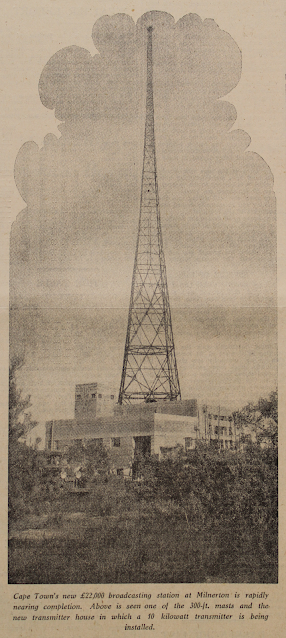
Cape Town’s new £22 000 Broadcasting Station at Milnerton
CAPE TIMES - 1933, July 18 The Cape and Peninsula Broadcasting Association started Cape Town’s first Broadcasting Station on September 15, ...
-
CAPE TIMES - 1933, July 18 The Cape and Peninsula Broadcasting Association started Cape Town’s first Broadcasting Station on September 15, ...
-
CAPE ARGUS - 1875 & 1918 DE VOLKSTEM - 1925 Interesting to read about Dental Care available in Cape Town, South Africa, si...
-
CAPE TIMES - 1924, April 8 City Tramways Company Ltd. provides a luxurious means of seeing what is admittedly the finest mountain sce...
.png)
.png)
.png)


.png)